Categories
Publications Research

Published: Refuges for fauna in fire-prone landscapes — their ecological function and importance

Authors: Robinson NM, Leonard SWJ, Ritchie EG, Bassett M, Chia EK, Buckingham S, Gibb H, Bennett AF and Clarke MF

Summary

Rapid environmental change is placing increasing pressure on the survival of many species globally. Ecological refuges can mitigate the impacts of change by facilitating the survival or persistence of organisms in the face of disturbance events that would otherwise lead to their mortality, displacement or extinction. Refuges may have a critical influence on the succes- sional trajectory and resilience of ecosystems, yet their function remains poorly understood.

We review and describe the role of refuges in faunal conservation in the context of fire, a globally important disturbance process.

Refuges have three main functions in relation to fire: they enhance immediate survival during a fire event, facilitate the persistence of individuals and populations after fire and assist in the re-establishment of populations in the longer term. Refuges may be of natural or anthropogenic origin, and in each case, their creation can arise from deterministic or stochas- tic processes. The specific attributes of refuges that determine their value are poorly known, but include within-patch attributes relating to vegetation composition and structure; patch- scale attributes associated with their size and shape; and the landscape context and spatial arrangement of the refuge in relation to fire patterns and land uses.

Synthesis and applications: Refuges are potentially of great importance in buffering the effects of wildfire on fauna. There is an urgent need for empirical data from a range of eco- systems to better understand what constitutes a refuge for different taxa, the spatial and tem- poral dynamics of species’ use of refuges and the attributes that most influence their value to fauna. Complementary research is also required to evaluate threats to naturally occurring ref- uges and the potential for management actions to protect, create and enhance refuges. Knowledge of the spatial arrangement of refuges that enhance the persistence of fire-sensitive species will aid in making decisions concerning land and fire management in conservation reserves and large natural areas. Global change in the magnitude and extent of fire regimes means that refuges are likely to be increasingly important for the conservation of biodiversity in fire-prone environments.

Robinson NM, Leonard SWJ, Ritchie EG, Bassett M, Chia EK, Buckingham S, Gibb H, Bennett AF, Clarke MF (2013) Refuges for fauna in fire-prone landscapes: their ecological function and importance. Journal of Applied Ecology DOI PDF

Categories
Research

Big Desert update 2

I’ve just returned from a glorious two-week family holiday in sunny north Queensland. How I’ve missed the place, so much cool wildlife everywhere! Among the highlights were spotting a male cassowary with three chicks (my son is currently obsessed with these oversized birds), watching platypus swim from our front veranda on the Atherton Tablelands — if you’re looking for a biologist’s paradise you can’t go wrong here — and taking the kids spotlighting for NQ’s arboreal mammals. We missed out on tree kangaroos, alas, but we did see green ringtail, lemuroid, and Herbert River ringtail possums, coppery brushtail possums and long-nosed bandicoots. And at age five, Rohan seems to be well on his way to a successful career in field ecology, spotting the eye-shine of many possums himself.

But enough on holidays; what I’d like to update everyone on is the first results to roll in from our Big Desert work. As I’ve written previously, this is an incredibly remote and largely unstudied region, so there’s much to be discovered and learned. What have we found so far? Well, I’ll let the video, below, do most of the talking, but what’s most exciting is that we’ve confirmed there is a dog population in the park, and some individuals appear to look very much like dingoes. We always suspected this, but it’s nice to have positive confirmation. Another interesting result is that goats were not recorded on any of the cameras so far, as compared to the Murray Sunset National Park, to the north, where goats are very abundant, but dogs/dingoes are absent. It’s early days, the habitats of Murray Sunset and the Big Desert / Wyperfeld region are somewhat different, and I’m sure we’ll find some goats in the region soon enough, as they’ve been recorded there. But, it does suggest dingoes may be playing a role in keeping goat numbers down, as we know they do from other studies conducted in other parts of Australia .

Some may remember the Victorian Government recently reviewed the evidence for the existence of big cats; the legendary Black Panther. Well, we may just have found it ourselves! (second-last clip in the video). On a serious note though, cats appear to be relatively common, and great variation exists in their morphology (as seen on the videos). Cats are known to be a major factor behind the extinction of many native species, and new research also shows how they have large impacts on wildlife through the spread of toxoplasmosis. We’re keen to understand more about the role of foxes and dingoes in suppressing cats and therefore disease transmission, but more on that later…

No rest for the wicked. I’m off to Belfast next week to attend the 11th International Mammalogical Congress. I’ll be speaking about the dingo barrier fence and co-chairing a symposium on trophic cascades, ecological restoration and conservation of mammals. I’m really looking forward to a week of listening to mammal research from around the world, and perhaps just a wee Guinness or two as well.

Categories
Publications Research

A cost-effective and informative method of GPS tracking wildlife (video)

In wildlife research, our ability to track sufficient numbers of individuals by GPS is typically limited by cost.

This video describes how to modify an inexpensive off-the-shelf GPS device for use in the field.

This video accompanies a paper, recently accepted for publication in Wildlife Research.

Categories
Research

Australian Museum Eureka Prizes: Finalist

Eureka! We’re finalists in this year’s awards.

Presented annually by the Australian Museum, the Eureka Prizes reward excellence in the fields of research and innovation, leadership and commercialisation, school science, and science journalism and communication.

Categories
Research

From the Big Desert

One of the main reasons this website exists is to increase outreach, or put more excitingly, to share with everyone the super cool conservation stuff I’m passionate about and fortunate enough to do as part of my job!

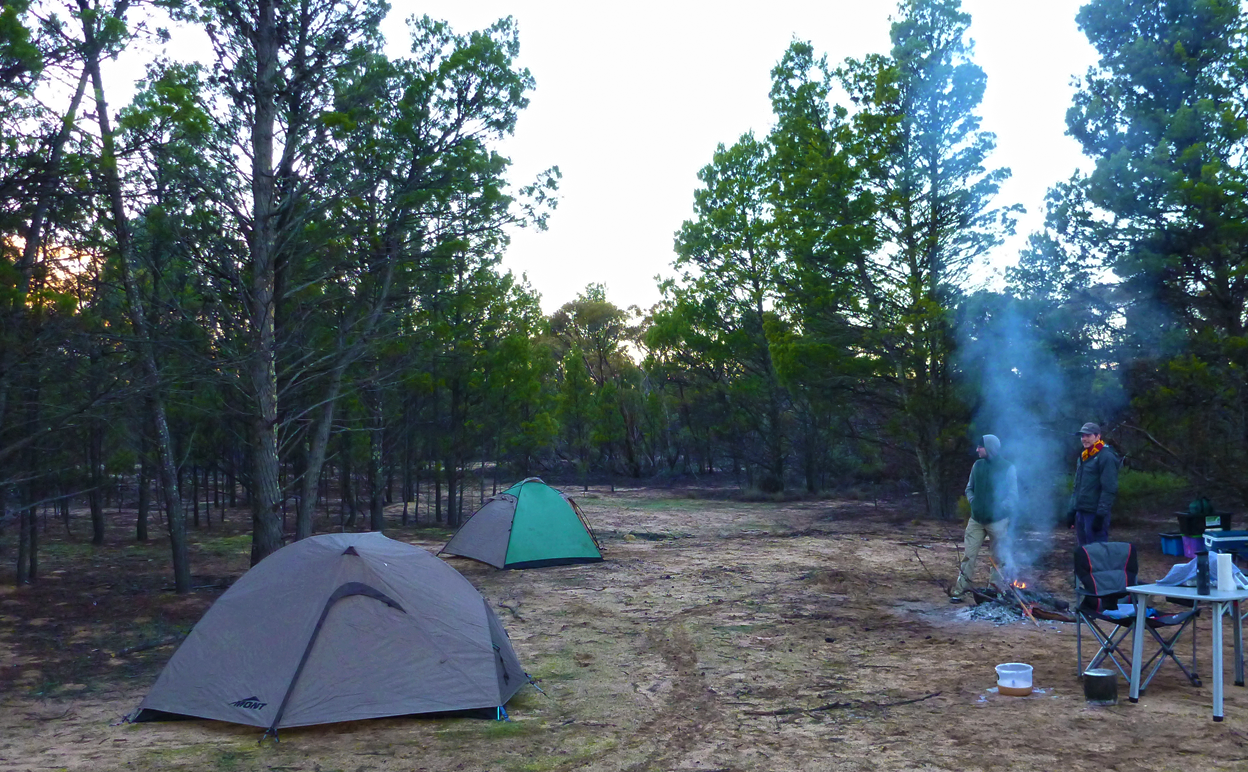
I’ve just got back from one of my new favorite places, Victoria’s Big Desert / Wyperfeld region. This region is about as remote as Victoria gets. It’s a large, relatively intact section of Mallee heath that is characterised by seemingly endless white sand and large dune systems.

The Big Desert / Wyperfeld system is vast and stunning!

On first glance, one could be forgiven for thinking this system is ‘simple’. However, its faunal diversity, particularly its reptiles, is quite outstanding, and the diversity of plants is well known. However, my reason for visiting this region recently was not to look at reptiles or admire the floristic diversity, but rather to examine other curious inhabitants of the region. Predators and herbivores, in particular dingoes/wild dogs and foxes, and kangaroos and goats, respectively.

Just what story does the owner of these footprints have to tell?

The aim is to examine what areas of the landscape dogs are using and whether this in turn affects the distribution and abundance of kangaroos and goats, as we know occurs elsewhere in Australia. This is important work, as the dog population in this part of Victoria is unlikely to consist of ‘pure’ dingoes, and we know little about what ‘wild dogs’ do. The question is: what ecological function do these dogs perform?

Of course, dogs can also have impacts on livestock, particularly sheep, so we’ll be looking at what dogs are eating too (through various means including scat analysis) and how they use the public- and private-land interface (along a gradient from outside to inside the Big Desert / Wyperfeld park region).

Two honours students (Thomas Healey and Jessica Lawton) will also be starting work in the region very soon. Tom will be examining predator-predator interactions, and Jess, the response of small mammals to the presence of predators and fire. Together these studies will build on previous research in the region. And, as always with this type of work, we’ll be looking for eager volunteers to help us out.

Lastly, a piece of advice, when you travel to the Victorian desert in June, don’t forget your sleeping bag, imagine how cold that would be…!

Even Mallee roads get busy.
It was cold up there, ice-on- the-windscreen cold. Lucky I was prepared, oh wait…
Categories
Research Uncategorized

Fully funded on Pozible!

I’m thrilled to announce that we have reached our $20,000 funding target on Pozible, a little over 48 hours ahead of deadline.

A huge thank you to everyone who supported the project, helped to spread the word, or made a donation — large or small.

PozibleFullyFunded

We will now be able to begin our project: the first comprehensive camera trapping study of animals in the spectacular and remote Torricelli Mountain range in Papua New Guinea. We will build on the already amazing work of the Tenkile Conservation Alliance (TCA) and strengthen the alliance’s partnership with Deakin University.

This is something tangible we can do to help arrest the extinction crisis. Engendering hope is critical.

It has been wonderful to see science and conservation capturing the public’s imagination. I really hope the crowd funding model continues to increase the connection between the public and the scientific communities.

My first foray in to crowd funding has been exhilarating, humbling and exhausting… all at once!

One more thing: if you haven’t pledged but would like to help out, there is still time. More dollars means more cameras, which means more data. Or, if you would like to help out my Deakin colleagues, there are still 5 exciting projects that need support.

Again, on behalf of myself and the TCA, a huge thank you. We are very, very excited to get cameras out and start discovering just what’s out there!

Categories
Research

80% funded on Pozible. Four days to go!

Pozible80percentFunded4DaysToGo

Categories
Research

Tenkile updates

I’ve been busy garnering support and raising awareness for our crowd funding campaign.

Check out the full update on Pozible.

In short:

  1. The Tenkile Conservation Alliance opened its new research centre.
  2. Polyglot extraordinaire Stephen Fry threw his weight (and that of his six million Twitter followers) behind the project.
  3. I’ve continued my media assault.
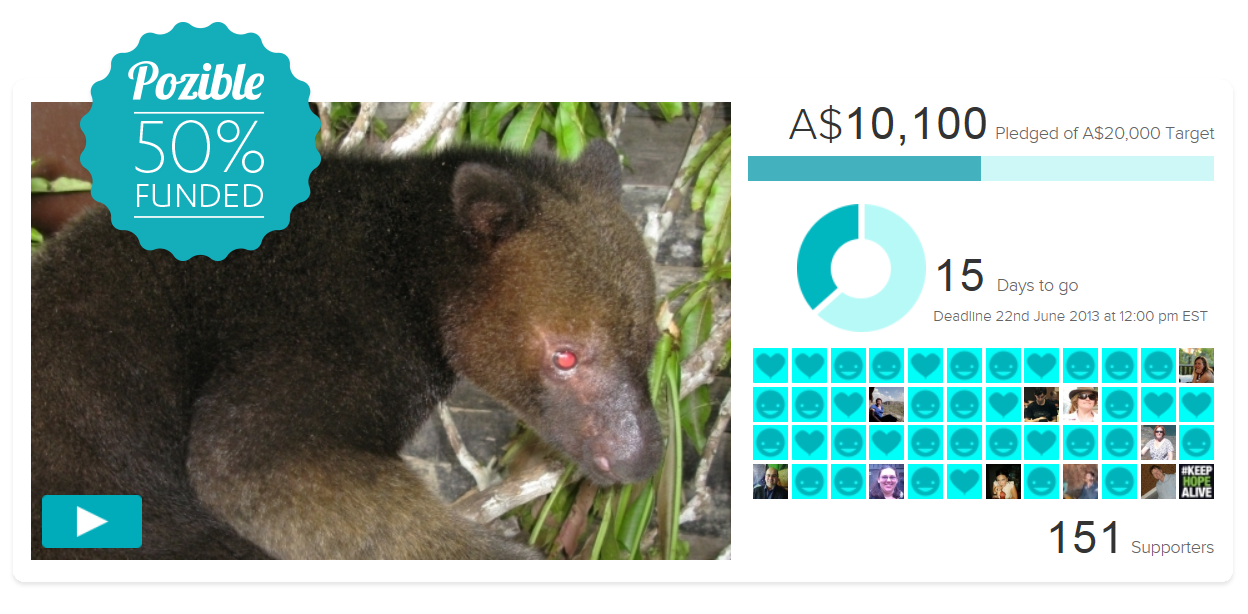
  4. And, we hit the $10,000 mark: 50% funded on Pozible.

Please continue to spread the word and thanks again for all your support.

Categories
Research

50% funded on Pozible!

Pozible50percentFunded

Categories
Research

Twitter: Stephen Fry

Wow: An endorsement from Stephen Fry!

Help us to reverse the extinction crisis and save some of Papua New Guinea’s most special and irreplaceable animals.

Pledge your support at pozible.com/tenkile

Categories
Media Research

ABC Radio: Talking tenkiles with Tony Peacock

Tony Peacock, CEO of the Cooperative Research Centres Association, was kind enough to give me a voice on ABC Radio today with Alex Sloan.

In this interview we talk about the potential of crowdfunding for Australian research, and the role it may play in my own project: discovering the mountain mammals of the Papua New Guinea mountains.

Categories
Research

Papua New Guinea’s mountain mammals, a crowdfunding campaign

The Papua New Guinean mountains are home to amazing and endemic animals including the critically endangered Tenkile and Weimang tree kangaroos. Many of this region’s fauna are under severe threat of extinction.

Our project, a partnership between Deakin University and the Tenkile Conservation Alliance is the first comprehensive camera-trapping study of animals in the spectacular and remote Torricelli Mountain range. We will use automated, motion-sensing cameras to collect crucial information about these animals to establish the habitats that are most important – critical information if we are to save them.

I’m excited to be part of an Australian university first – using ‘crowdfunding’ to raise money for research. Our goal is $20,000, and we’re using the Australian crowdfunding website Pozible.

Please consider donating or, equally important, help us to spread the word.

Pozible: Discovering Papua New Guinea’s Mountain Mammals

Facebook group: Discovering Papua New Guinea’s Mountain Mammals

Deakin University Newsroom: Deakin Makes Research Pozible

Tenkile Conservation Alliance