
NPR’s Christopher Joyce speaks to Michigan Technological University Research Professor and internationally renowned wolf expert Rolf Peterson and Science review lead author William Ripple about the interconnectedness of big predators in nature.
Category: Media
![Without tigers, our ecosystems will suffer. Image by Sascha Kohlmann [CC-BY-SA 2.0] via Flickr](https://euanritchie.org/wp-content/uploads/2014/01/tiger-flickr-sasha-kohlmann-1248x772px.jpg)
But new research in the journal Science shows that our inability to live with these animals is putting their survival in great danger, and doing untold damage to the environment.
Through modifying the habitats of large predators or killing predators more directly, we are greatly compromising the ecosystems that they help to keep in balance — free of charge. In turn this environmental degradation creates many problems that have severe consequences for humans.
![We ain’t lion, this predator stuff is a big deal. Image by Derek Keats via Flickr [CC BY 2.0] via Flickr](https://euanritchie.org/wp-content/uploads/2014/01/lion-derek-keats-flickr-1248x772px.jpg)
Top dogs (and cats) under threat
For the first time, a team of researchers from the United States, Australia, Italy, and Sweden, and led by Professor Bill Ripple at Oregon State University, have analysed the effects of threats such as habitat loss, human persecution and reduced prey on the world’s 31 largest mammalian carnivores.
The species studied include lions, tigers, African wild dogs, leopards, cheetahs, wolves, lynx, otters, bears, hyenas and dingoes. Together they span all continents except Antarctica.
Alarmingly, more than three quarters of the 31 large carnivores are in decline, and 17 species occupy less than half of their historical distributions. The Red Wolf in the southeastern United States is now found in less than 1% of its historical range, and the Ethiopian Wolf in just 2%.
Hotspots of carnivore decline are southeast Asia, southern and East Africa, and the Amazon, where several large carnivores are declining. And in the developed world there are now few places where large carnivores remain.
![In Australia, dingoes help keep introduced predators at bay. Image credit: Ars Electronica [CC BY-NC-ND 2.0] via Flickr](https://euanritchie.org/wp-content/uploads/2014/01/dingo-ars-electronica-via-flickr-1248x772px.jpg)
Ripple effect
Seven carnivore species in particular have been shown to have profound effects on the environment and cause what is known as “trophic cascades”. A trophic cascade is a ripple effect, where one species’ influence spreads through multiple levels of a food web.
Species for which this effect is most well-known are African lions, leopards, Eurasian lynx, cougars, gray wolves, sea otters and dingoes.
![It’s hard being a VIP (very important predator). Image credit: Mike Baird [CC BY 2.0] via Flickr](https://euanritchie.org/wp-content/uploads/2014/01/sea-otter-mike-baird-via-flickr-1248x772px.jpg)
In coastal North America, sea otters keep sea urchin numbers in check, which helps maintain kelp forests and benefits other marine species dependent on this habitat. But in this case otters might also offer a defence against climate change, as healthy kelp forests can grow rapidly and store large amounts of carbon.
And in Africa, a decrease in lions and leopards has coincided with a dramatic increase in Olive Baboons, which threaten farm crops and livestock, and spread intestinal worms. Baboons even impact education, as children have to stay home to defend their farms from raids.
![Without lions and leopards, there’s no telling what baboons will do. Image credit: Justin Jensen [CC BY 2.0] via Flickr](https://euanritchie.org/wp-content/uploads/2014/01/baboon-justinjensen-via-flickr-1248x772px.jpg)
Together we call on governments to end policies and management practices that are responsible for the ongoing persecution and loss of predators from our planet. Western Australia’s new shark plan is an example of management that fails to account for the science of big predators. Instead we need an international initiative that aims to conserve large predators and promote their coexistence with people.
This article was originally published at The Conversation. Read the original article.


This article was originally published at The Conversation. Read the original article.
I have just returned from the jungles of Papua New Guinea, where for two weeks a team of us have set camera traps that will collect vital information about the biodiversity of this remote region. It’s all in the name of protecting some of the world’s rarest animals, including the Weimang and Tenkile tree kangaroos. But what’s it like working in the PNG jungles?
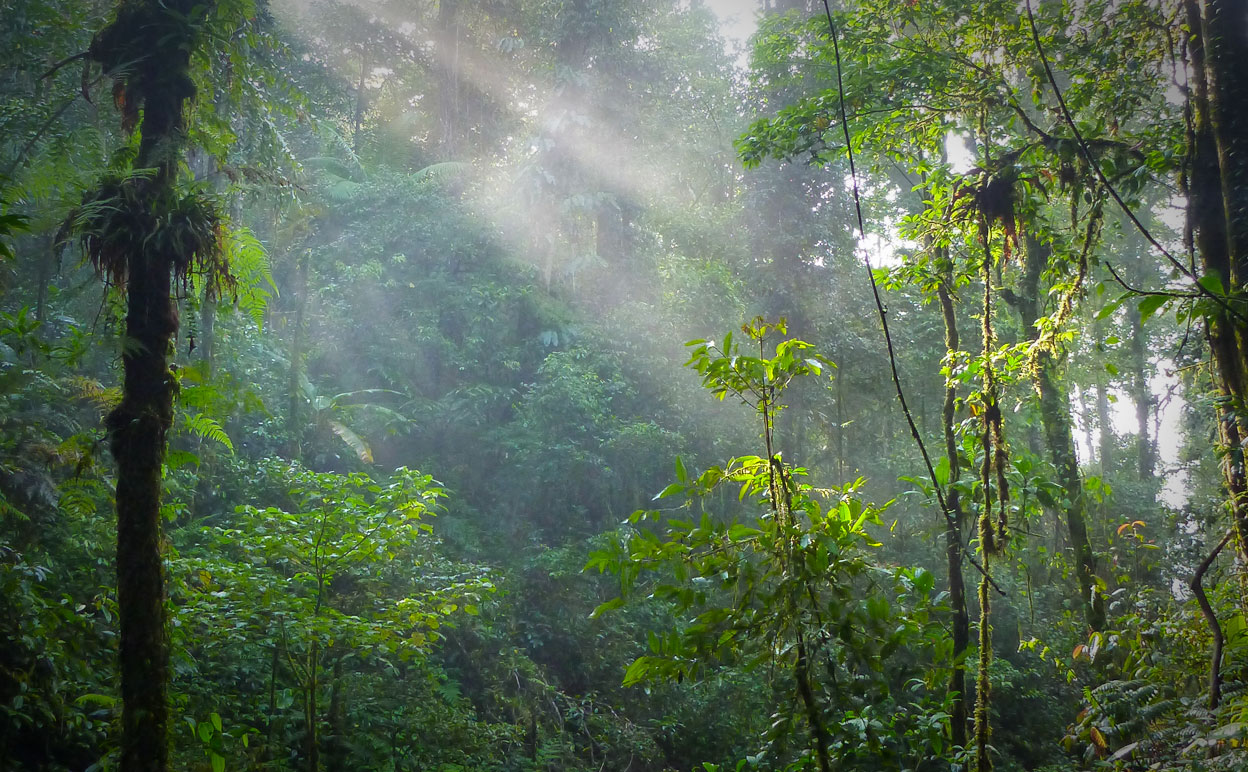
We were working in a remote region of PNG known as Yauoru. I knew the place was remote — most of PNG is — but I hadn’t appreciated just how remote.
Beginning our five day walk from the Tenkile Conservation Alliance (TCA) turned to one of our support staff and asked if any white people had been here. The answer was no, never. Being allowed to visit such a special area was an immense privilege. That five day walk was undoubtedly the hardest walk I’ve done, a genuine test of endurance. The first day we walked from Ningal to Uwei (villages close to Yauoru), where Samuel Kabau, a local Uwei villager and Tenkile Conservation Alliance staff member lives. Along the way we passed through cocoa plantations, lowland rainforest and made our first of many river crossings. This took a little over six hours. But that was just day one.

After leaving Uwei we began a long, long walk up the river Obin, crossing raging rapids, leaping over boulders and navigating narrow canyons. I gained an appreciation for the strength of local Papuans as compared to myself. While I plodded with waterlogged boots, drenched to the bone by tropical rains, the locals carried heavy gear and pulled me through rapids so I wasn’t swept away, all in bare feet. And all the time chewing betel nut and smoking cigarettes.

After five hours I got my hopes up that we were close to base camp, but I was sadly wrong. After leaving the river we walked and crawled up the side of a mountain at an angle exceeding 45 degrees. Again my local friends — weighing 50–55 kg — stepped in to help lift and shove my 75 kg frame up the slope.
We arrived at base camp where some of our team had gone ahead and built a hut and boiled a billy — which in this case was a bamboo stem. Eat your heart out coffee snobs, I’ve had coffee from a bamboo stem on top of a remote PNG mountain.
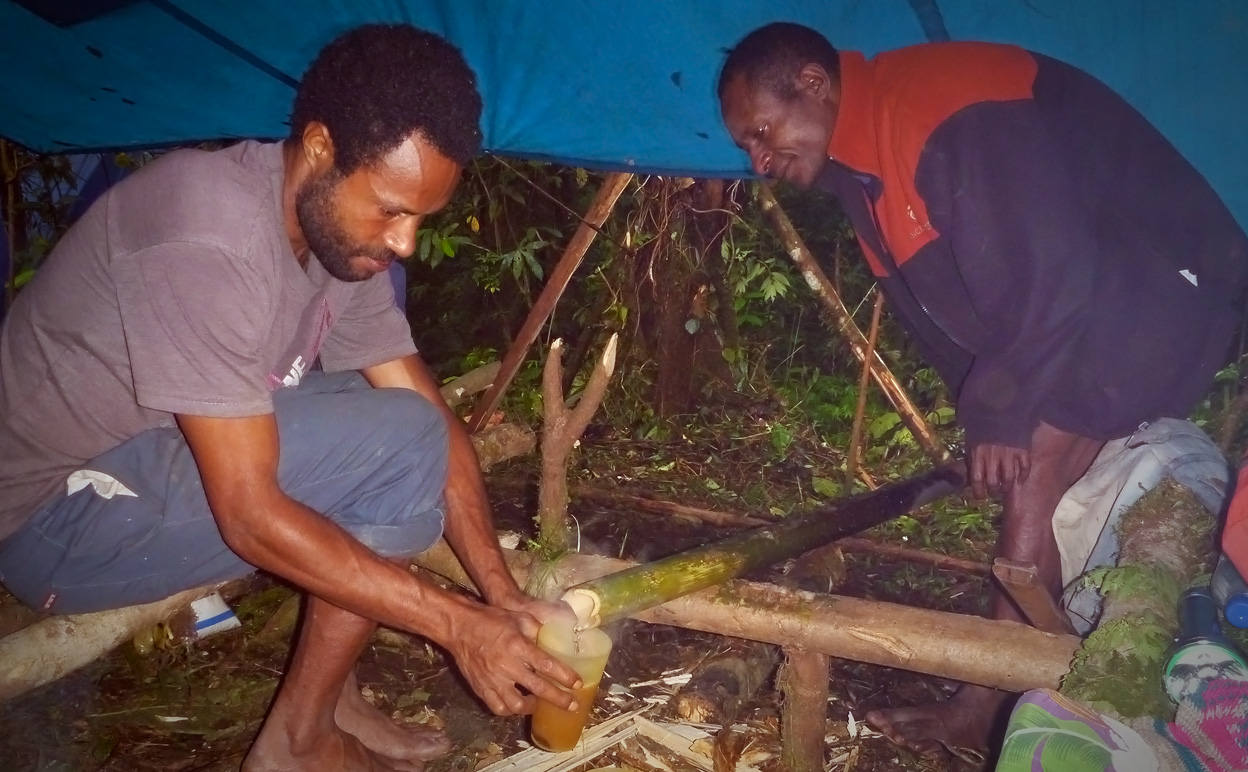
On day three Jim and I trekked to the top of the mountain to place cameras (the exact location is a secret). We put out 26 cameras, ranging from 1100 m to around 1400 m above sea level.
We’d planned for 36 and at a greater range of elevations, but technical issues (more commonly known as Murphy’s Law), prevented us. Below 1100 m the mountain was too steep to stay upright!
Some of the cameras were baited with peanut butter, honey, and vanilla essence for animals who have a sweet tooth; that’s tree kangaroos. Others we baited with tuna oil for predators such as Salvadori’s Monitor, which reportedly can grow to greater than four metres. The locals describe it as a crocodile that climbs trees. Fortunately I didn’t encounter the monitor at night, but I hope our cameras do.
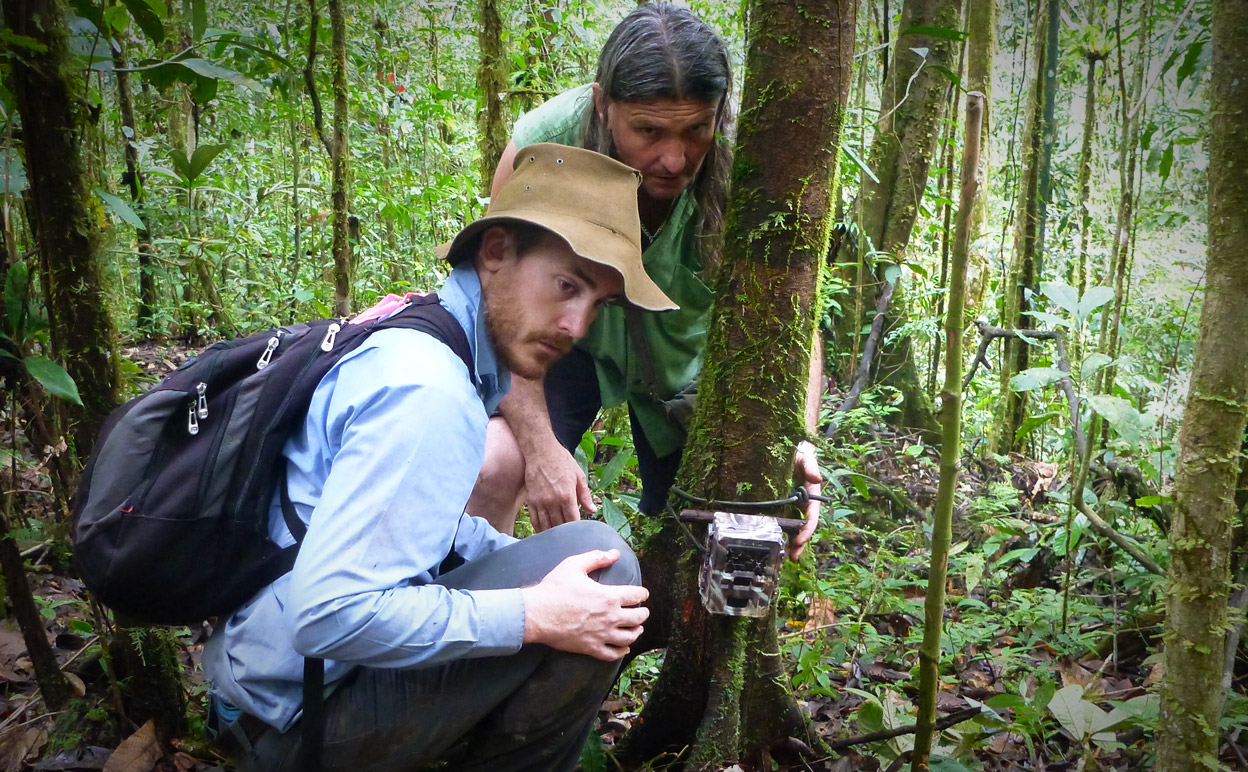
Now the waiting game begins. Our cameras are set to be retrieved in February next year. Animals are most likely walking past our cameras right this moment, but we’ll have to wait several months to find out just which ones. While helping to conserve endangered tree kangaroos, hopefully the project will show the positive effects of work by the Tenkile Conservation Alliance and the hunting-free zone the organisation has established in the Torricelli Mountains. It also demonstrates how vital local communities are for conservation. Without them, our expedition would have failed.
Read more about my Papua New Guinea expedition here, and stay tuned for more next year.

Few would argue the world isn’t facing enormous challenges: human population growth and the associated demand for resources, mass extinctions or – perhaps the biggest of all – global climate change.
We often look to science to help provide solutions. But if science is to succeed in doing so, society may need scientists to take more risks, think outside the box and, dare we say it, think “dangerously”.
![Without taking risks, science won’t solve big problems. Image by Andrew "FastLizard4" Adams via [CC BY-SA 2.0]Flickr](https://euanritchie.org/wp-content/uploads/2013/11/dangerousscienceflickr.jpg)
But what exactly do we mean by thinking dangerously? In short, scientists need room to propose ideas that could seem too far-fetched or controversial at first glance, such as introducing elephants to Australia to manage weeds.
What use are such dangerous ideas?
Oscar Wilde perhaps put it best: An idea that is not dangerous is unworthy of being called an idea at all.
Dangerous ideas always stimulate fresh thinking, sometimes with profound outcomes.
To illustrate we only need look at perhaps the most dangerous idea of all time, evolution via natural selection, simultaneously proposed by Charles Darwin and the oft forgotten and desperately unfortunate Alfred Russel Wallace. Their idea changed the very course of human history, in how we view the relationships between Earth’s many millions of different inhabitants, and our own place within it.
The most famous example of dangerous science being punished could be heliocentrism, originally proposed by Galileo. Galileo paid a high price for his theory about how Earth and other planets move in relation to a largely stationary sun. Tried by the Inquisition, he was found guilty of being suspected of heresy and spent his remaining days under arrest.
Fortunately we’ve moved on from then but dangerous thinking in science is still attacked. One must only look at the way the science of climate change, and indeed climate change scientists, are often attacked.
Or consider the response to Mark Davis’ recent dangerous idea that species should be judged more by their function than their origin because some alien species have positive ecosystem impacts. More than 140 scientists replied in outrage at the suggestion that we should in any way relax efforts to control alien species, which have been devastating to so much wildlife around the world.
Not dead yet
Thankfully, despite the rise of occupational health and safety, the dangerous idea is not quite dead yet. A recent symposium run by the Royal Zoological Society of NSW set out to propose dangerous zoological ideas. They wanted ideas that could turn out to be right, wrong or irreverent, but most certainly not boring, safe and uninventive.
A full list of the ideas proposed is here and a flavour of the meeting and discussion here. But some of the most stirring presentations were as follows:
- Corey Bradshaw and Barry Brook suggested if we want to maintain our energy demands and lifestyles, but still also conserve biodiversity, we must have nuclear power in Australia’s energy mix. Did you know that a person’s entire lifetime’s worth of energy consumption is contained in one golf ball-sized piece of uranium and this has zero emissions? The same amount of energy in coal would be equivalent to the weight of 800 elephants worth and 3,000 elephants worth of emissions! That’s some telling maths, even for the most ardent critic of nuclear power.
- Ian Wallis told everyone, most notably Mike Archer, that vegetarians certainly do not have more blood on their hands than omnivores. Why? Because two of the main and increasing sources of protein consumed by humans, pork and chicken, require crops to be produced for their production. So even before you’ve tucked into a drumstick or piece of bacon, you’ve indirectly consumed significant amounts of vegetable matter. Vegetarians by comparison just go straight to the source.
- Euan Ritchie (along with Corey Bradshaw again, clearly a very “dangerous” man) proposed we tear down the dingo barrier fence and implement different approaches for predator management and pest control, including the use of guardian animals. Fences, poison and bullets will not solve our pest management issues and conserve biodiversity long-term; in fact it could make things worse. What many people still fail to realise or acknowledge is that species don’t operate in isolation from others within ecosystems. So why do we continue to manage species as if they do? We need to try other approaches, such as rewilding and reintroductions to restore broken ecosystems.
- Peter Banks critiqued de-extinction and argued that without extinction there’s no basis to conservation. In another presentation on the same theme, Thom van Dooren discussed how humans mourn the extinct, and that this mourning is vital to conservation action. If humans think endangered species can be brought back by science and a techno-fix approach, what motivation is there to conserve anything? Banks’ dangerous idea is that iconic extinct species such as Thylacines must remain extinct. They do more for conservation dead than they would if they lived again.
Desperate times need bold ideas and bold measures, even potentially “dangerous” ones. There are risks involved, but there are risks also in not being bold and willing to try different things too, especially when the payoffs may be huge. Science is about discovery. If we want to realise its full potential we must start being more adventurous.
 This article was originally published at The Conversation. Read the original article.
Much of my time as an ecology lecturer has been spent teaching students about the wonders of this planet’s biodiversity, but also regrettably, how much of this biodiversity is under severe threat. Hundreds, if not thousands, of species become extinct each year.
With such a disastrous outlook for the species with which we share Earth, it’s easy to get disheartened about where we’re headed. More personally, I often question whether my own fields of science (ecology and conservation biology) are really enough to help stem the extinction tide.
But this week I’m embarking on a journey to Papua New Guinea’s remote Torricelli Mountains. It’s part of a crowd-funded project, Discovering Papua New Guinea’s Mountain Mammals that is a partnership between myself at Deakin University and Jim and Jean Thomas of the Tenkile Conservation Alliance. Together we will count and identify mammals as part of conservation efforts in the region, including some very special species of tree kangaroo.

Who or what is a Tenkile?
The Tenkile (pronounced ten-kee-lay) is one of 14 tree kangaroo species found in the tropical rainforests of New Guinea and Australia.
In 2001 there were only 100 Tenkile left in the Torricelli Mountains of PNG. To put that in perspective, there are thought to be around 1600 Giant Pandas in the world today. That made the Tenkile one of the world’s most endangered animals. The reason they’re still with us today is largely thanks to the work of the Tenkile Conservation Alliance.
The conservation alliance sets itself apart from many others by focusing on causes rather than symptoms of extinction. The Tenkile had become endangered due to over-hunting, so rather than ignore the needs of local people, the alliance places a strong emphasis on these communities who share the region with the Tenkile.
The reason for the bounce back of Tenkiles is a switch from hunting to more sustainable and reliable sources of protein, including farmed rabbits and chickens. Along with improved education about the local community’s wildlife, and health and living conditions, there has been a real reversal in the once dire trajectory of the region’s wildlife. Thanks to these actions there are now more than double the number of Tenkile there were in 2001.
Professor Tim Flannery, himself no stranger to the wilds of PNG, wrote:
A decade on, the Tenkile Conservation Alliance is the most successful conservation organisation in Melanesia … and no other organisation I know of in a developing country has had anything like this degree of success.
What do we hope to achieve in PNG this time?
Our upcoming trip will take us to the northwestern Torricelli Mountains near the Waliapilik area in Sanduan Province. Over two weeks we’ll place 35 remote, motion-sensing cameras out along lines and an elevation gradient ranging from 500 to 1500 m above sea level. These will help us determine a number of things, including:
- Are tree kangaroo species (including the Weimang, Tenkile and Yongi) found within the region?
- If present, how many individuals of each species are there?
- What habitats are most important for each species?
- Are species only found at specific elevations and in particular climates, and hence how susceptible could species be to the impacts of global climate change?
To say this trip is full of anticipation is putting it lightly. Along with the critical information we aim to collect on tree kangaroos, we also suspect new species are to be found in the area, including miniature wallabies and echidnas.
When we retrieve our cameras in a few months time it’s going to be exciting to see what we find, and it’s almost guaranteed that there will be many firsts for science. Because camera traps detect and record anything that moves past them, we’ll collect valuable data on a large range of species.
Thanks to all who have helped get us this far. This is just the beginning, and if you’d like to contribute or stay in touch please contact me here.
This article was originally published at The Conversation. Read the original article.

Can recreational hunters control feral animals? Is there a role for so-called “conservation hunters”? And is their claim backed by science?
What about the introduction of native predators, such as dingos, or companion animals such as alpacas?
These questions are explored by Anja Taylor on the ABC’s popular science program, Catalyst.
The video and a transcipt is available from the Catalyst archive.
Kookaburras, koalas and kangaroos — Australia is well known for its charismatic animals and vast, seemingly untamable, wild spaces. But throughout the country, the national parks and reserves that protect these unique animals and ecosystems have come under increasing threat. New rules and relaxed regulations, which bolster immediate economic growth, are putting pressure on Australia’s already-threatened biodiversity.
I’m extremely excited, proud and humbled to announce that I am part of a collaborative research team awarded this year’s NSW Office of Environment and Heritage Eureka Prize for Environmental Research.

Our research centres on the much-maligned and often polarising predator: the dingo.
Though sometimes miscast as vermin, our research shows that dingoes are key elements in the struggle to reduce damage caused by foxes, feral cats and even kanagroos; and that ecosystems with dingoes have better vegetation and more diverse and abundant populations of small native mammals. In fact, a good dose of our native dog can sustain biodiversity and help land managers control invasive species.
Part cultural icon, part livestock pest, Australia’s largest terrestrial predator is also an important component of healthy ecosystems and a useful contributor to environmental recovery and the protection of threatened species.
‘Team Dingo’ is:
- Professor Chris Johnson, University of Tasmania
- Dr Michael Letnic, University of New South Wales
- Dr Euan Ritchie, Deakin University
- Dr Arian Wallach, James Cook University
- Adam O’Neill, Evelyn Downs Station.

On behalf of the team, I would also like to congratulate our fellow Eureka finalists: Dr David Post, Dr Francis Chiew (CSIRO), Dr Bertrand Timbal and Dr Harry Hendon (Bureau of Meteorology) for their work on the causes and predictability of climate variability and its impacts on water availability; and Dr Jason Sharples (University of New South Wales) and Richard McRae (ACT Emergency Services Agency) for their research on the causes and effects of catastrophic firestorms.
Presented annually by the Australian Museum, the Eureka Prizes reward excellence in the fields of research and innovation, leadership and commercialisation, school science and science journalism and communication.
Another attack on Fraser Island — the flashpoint for dingo management issues — has highlighted our complex relationship with Australia’s largest terrestrial predator.
![The Fraser Island Dingo is in the news for all the wrong reasons. Image by Glen Fergus [CC-BY-SA-2.5], via Wikimedia Commons](http://upload.wikimedia.org/wikipedia/commons/4/4c/Dingo_Fraser_Is.jpg)
Recent research from around the globe is demonstrating that large predators, like wolves and dingoes, play a critical role in maintaining healthy ecosystems.
Last week the world was appalled when Ecuador decided to open up one of its iconic national parks for petroleum development. Yet the world should be even more disappointed in Australia, a far wealthier nation whose parks could be facing even worse threats.
Why is Australia going down this reckless path? It’s all down to the state governments.
This letter was originally published in Nature on behalf of 21 co-signatories. DOI
Policy and legislative changes by Australia’s state governments are eroding the vital protection of the country’s unique biodiversity.
Reserves are being opened up to ecologically disruptive activities, such as grazing by domestic livestock, logging, mining, recreational hunting and fishing, and commercial development. Protected habitats on private and leasehold land are imperilled too. Queensland and Victoria, for example, are relaxing hard-won laws that limit vegetation clearance on private land, further accelerating the loss of regional biodiversity.
Collectively, these actions increase the pressure on biodiversity conservation in protected areas, many of which are already showing biodiversity loss (for example, the Kakadu National Park in northern Australia). Ecological connectivity is being lost, which will hamper the dispersal of species and their ability to respond to climate-change effects.
Species extinctions are primed to increase. Too many of the country’s unique fauna and flora have been wiped out over the past two centuries (see, for example, C. Johnson Australia’s Mammal Extinctions; Cambridge Univ. Press, 2006), including the Christmas Island pipistrelle bat (Pipistrellus murrayi) in 2009.
There could be no worse time to weaken reserve protection and relax laws designed to reduce habitat loss.
Recent laws allowing hunting and logging in our parks are misguided. Our reserves protect biological diversity and shouldn’t be used otherwise.
![99-year private leases granted by the Victorian Government open the door to inappropriate development in national parks, such as Wilsons Promontory. Image by Steve Bennett [CC-BY-SA-3.0-2.5-2.0-1.0] via Wikimedia Commons.](https://euanritchie.org/wp-content/uploads/2013/06/wilsonspromnatpark_wikimediacommons.png)
I added my voice to that of 16 eminent Australian ecologists to draw attention to this extremely important issue.
Read the full article (and comments) at The Guardian website.
I was featured today on the School of Life and Environmental Science’s news page.
I’ve been pretty busy getting the message out there on mainstream and social media lately. The message: extinction affects us all. Because of our impacts, we are losing thousands of species each year, leaving us culturally, economically, emotionally and environmentally the poorer. Society’s biggest challenge — and arguably failure — is the continuing loss of species from Earth.
The article shone a light on some of my recent media presence, from my opinion piece on The Conversation to a tweet that Stephen Fry shared with his six million followers.
Australia boasts over 500 national parks covering 28 million hectares of land, or about 3.6% of Australia. You could be forgiven for thinking we’re doing well in the biodiversity-conservation game.
But did you know that of those more than 500 national parks, only six are managed by the Commonwealth Government?
![Kakadu National Park – our biggest and possibly most important national park – is a global conservation embarrassment. Image by Cgoodwin [CC-BY-3.0] via Wikimedia Commons](http://commons.wikimedia.org/wiki/File:Kakadu_brumbies.jpg)
As ecologists and conservation scientists, we couldn’t agree more with the intent of this proposal, although we have several recommendations and caveats.
Mongabay.com is one of the world’s most popular environmental science and conservation news sites and publisher of Tropical Conservation Science, a peer-reviewed, open-access academic journal that seeks to provide opportunities for scientists in developing countries to publish their research in their native languages.
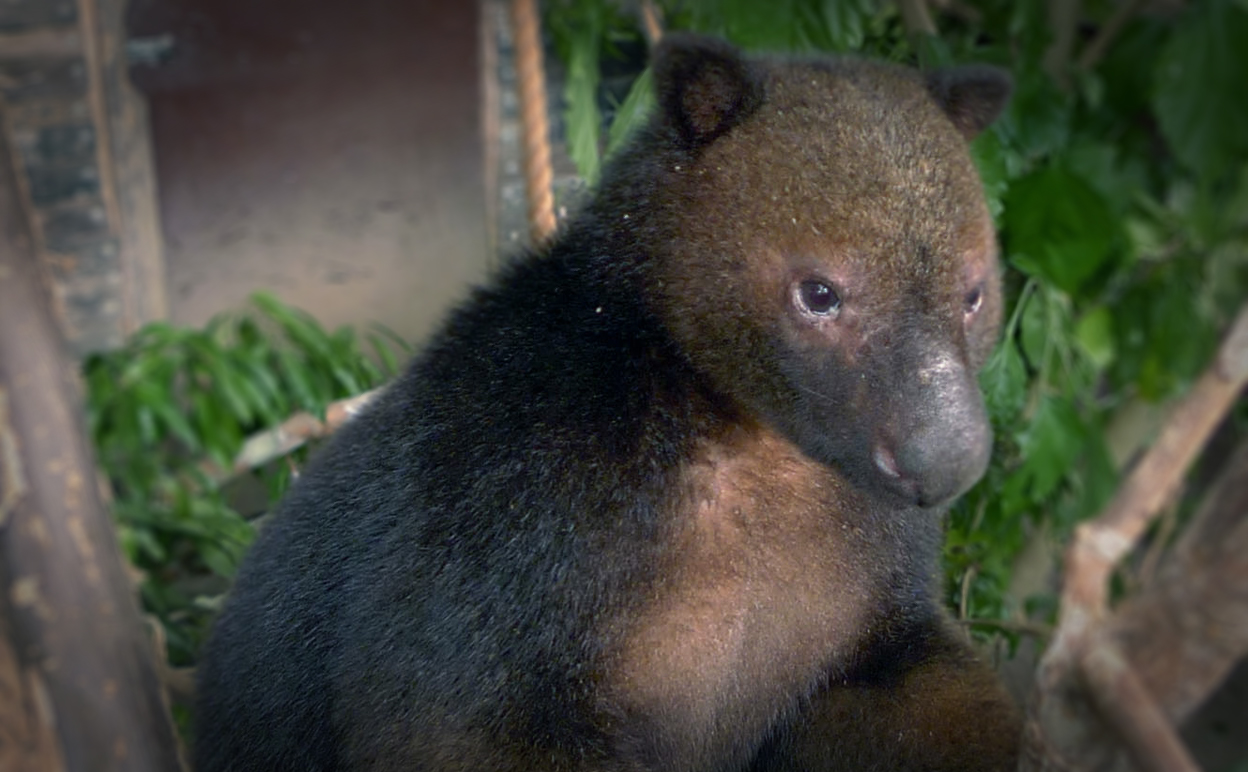
Here’s my interview with Jordana Dulaney on the decline of the tenkile, and my new project to conserve the species.
Tony Peacock, CEO of the Cooperative Research Centres Association, was kind enough to give me a voice on ABC Radio today with Alex Sloan.
In this interview we talk about the potential of crowdfunding for Australian research, and the role it may play in my own project: discovering the mountain mammals of the Papua New Guinea mountains.
Tensions between state and federal government are rising over the issue of how to manage national parks.
Today I chatted with Radio National’s Cameron Wilson about state / federal relations when it comes to our natural parks.
Experts are warning Australia’s National Parks are facing a ‘death by a thousand cuts’. As protections against grazing, hunting and logging within the parks relax, we are at risk of finding out first-hand just how fragile these eco-systems are, and why they desperately need protecting.
Professor Bill Laurance and I speak to The Wire’s Graham Backhaus.
![Kakadu National Park. Image: Thomas Schoch [CC-BY-SA-2.5], via Wikimedia Commons](http://upload.wikimedia.org/wikipedia/commons/d/d9/Yello_Water_Kakadu_National_Park_Australia.jpg)
National parks on land and in the ocean are dying a death of a thousand cuts, in the form of bullets, hooks, hotels, logging concessions and grazing licences. It’s been an extraordinary last few months, with various governments in eastern states proposing new uses for these critically important areas.
Did you miss today’s show on Triple R’s Einstein A Go-Go about extinction, crowd funding and trees kangaroos?
Don’t worry, you can listen to it here.
 Applied ecology and conservation research group