Categories
Publications Research Science communication

Nature under fire in Australia’s tropical savannas

Authors: Brett Murphy, John Woinarsk and Euan G Ritchie

Published in: Landscape Architecture Australia

The tropical savannas of northern Australia are highly vulnerable to changes in climate as well as to more direct human impacts.

Addressing these challenges will require urgent, coordinated action at all levels.

Murphy B, Woinarsk J, Ritchie EG (2025) Nature under fire in Australia’s tropical savannas. Landscape Architecture Australia PDF LINK

Categories
Publications Research

Feral horses and their environmental impacts in the Australian Alps: policy and management priorities

Authors: Ayesha IT Tulloch, Euan G Ritchie, and Don Driscoll

Published in: Austral Ecology

Summary

Feral horses cause extensive ecological harm, including damage to soil, waterways, vegetation, and the carbon cycle, leading to declines in threatened species.

While most Australian states pursue population reduction or removal, NSW’s Kosciuszko Wild Horse Heritage Act mandates retention of horses in parts of Kosciuszko National Park, contradicting scientific consensus and national conservation policies.

Scientific evidence strongly supports complete removal of feral horses from sensitive alpine and subalpine ecosystems, as fencing and local exclusion are insufficient.

Effective protection and restoration of damaged alpine ecosystems requires coordinated management of all invasive species, evidence-based public communication, and legislative support.

Tulloch AIT, Ritchie EG, Driscoll DA (2025) Feral horses and their environmental impacts in the Australian Alps: policy and management priorities. Austral Ecology PDF DOI

Categories
Publications Research

Habitat selection and movement behaviour of long-nosed potoroo in the presence of feral cats

Authors: Meg Farmer, Anthony R Rendall, Amy Coetsee, and Euan G Ritchie

Published in: Austral Ecology

Abstract

The global biodiversity extinction crisis is attributed to a series of key threats, with the introduction and impacts of invasive predators considered among the most damaging. Given that effective large-scale lethal control is often not logistically or financially feasible, alternative solutions to promote the persistence of native wildlife most at risk of predation—critical weight range mammals—must be sought. Understanding habitat use and selection of native prey under predation pressure with widespread and common invasive predators, such as feral cats, can quantify habitat elements that may promote survival.

We aimed to determine the movement behaviour of a population of critical weight range mammals persisting in the presence of feral cats. We established a trapping grid across ‘Bluegums’, French Island, in south-eastern Australia to collect morphometric, demographic and movement data by deploying GPS tracking devices on Long-nosed Potoroo (Potorous tridactylus trisulcatus). We used spatially explicit capture–recapture models to generate a potoroo density estimate, and autocorrelated kernel density estimators and dynamic Brownian Bridge Movement Models to examine home range and habitat use. Spatial overlap and habitat selection analyses were used to draw inferences about habitat selection and territoriality.

Potoroos persisted at low densities and had large home ranges (7.3–12.5 ha). Individuals selected for structurally complex habitat and appeared reluctant to move across open areas, potentially in response to greater perceived predation risk. The fine-scale movement data in our study elucidate the extent to which potoroos rely on vegetation structure, suggesting that maintaining habitat cover and connectivity is likely to build resilience and aid potoroos and similar species to co-exist with feral cats.

Given the ongoing threat feral cats pose to biodiversity, our results support the need for maintaining diverse, structurally complex vegetation to build ecosystem resilience to support improved conservation outcomes in the presence of invasive species.

Farmer M, Rendall AR, Coetsee A, Ritchie EG (2025) Habitat selection and movement behaviour of long‐nosed potoroo in the presence of feral cats. Austral Ecology PDF DOI

Categories
Publications Research

Lethal control of semi-arid, red fox populations fails to reduce their abundance but may create increased fox activity

Authors: Lorenzo Galletta, Anthony R Rendall, Matthew Lefoe, Mary Thorpe, Brit Hides, Ben Holmes, and Euan G Ritchie

Published in: Biological Invasions

Abstract

Biological invasions threaten biodiversity globally. In Australia, introduced and invasive European red foxes (Vulpes vulpes) are a major predator of native wildlife, and are implicated in numerous species extinctions, prompting large-scale fox population control programs. Lethal control—typically via poison (1080) baiting—is common, but the consistency of its efficacy has been questioned, and the desired outcomes are frequently not measured or evaluated.

We aimed to assess the success and impacts of lethal fox control on fox activity, and subsequent effects on a co-occurring, invasive mesopredator (feral cat, Felis catus), and native and invasive prey species. We surveyed three locations in the Wimmera region of Victoria, each experienced a different baiting regime (no baiting, standard systematic baiting, intensified baiting). Camera traps were deployed from April 2021 to August 2023 to determine predator activity alongside non-target herbivores.

Baiting treatment was not associated with differences in fox or cat activity. Nurcoung (no baiting) had the lowest activity of both cats and foxes across the study. Fox activity patterns under standard baiting were higher than intensified baiting.

Our results suggest that fox control might destabilise population dynamics of foxes, potentially facilitating increased activity levels through higher emigration rates from the surrounding agricultural environments.

Our study highlights the critical importance of appropriately monitoring the outcomes of invasive species control programs to ensure the a priori strategic objectives are achieved. To achieve more effective fox population suppression broader, landscape-scale approaches that take a nil-tenure approach are essential.

Galletta L, Rendall AR, Lefoe M, Thorpe M, Hides B, Holmes B, Ritchie EG (2025) Lethal control of semi-arid, red fox populations fails to reduce their abundance but may create increased fox activity. Biological Invasions PDF DOI

Categories
Publications Research

Megafire severity, fire frequency and their interactions with habitat affect post-fire responses of small mammal and reptile species

Authors: Don A Driscoll, Zac Walker, Desley A Whisson, Euan G Ritchie, Chloe Sato, and Kristina J Macdonald

Published in: Biological Conservation

Abstract

Climate change is driving extreme fires in many ecosystems around the world. There is an urgent need to understand how co-occurring and interacting threats compound megafire impacts on habitats and wildlife.

Using repeated surveys after the 2019–20 Australian megafires, we investigated how the abundance and occupancy of five small mammal and reptile species were influenced by fire severity, fire frequency, feral herbivore impacts, three key habitat components (logs, moss, and weeds), and their interactions.

We found that fire severity, fire frequency, weeds and logs were the most important factors affecting species abundance and occupancy. Increasing fire severity caused precipitous declines of the threatened broad-toothed rat Mastacomys fuscus and glossy grass skink Pseudemoia rawlinsoni. The impact of fire frequency depended on environmental covariates. High fire frequency led to low abundance of the water skink Eulamprus tympanum and M. fuscus if there were no logs. However, both species increased with fire frequency if logs were abundant, implying that logs can ameliorate negative impacts of frequent fire. The threatened Eulamprus kosciuskoi needed fewer than two fires in the past 80 years as well as high moss cover to achieve high abundance. Two threatened alpine skinks, E. kosciuskoi and P. cryodroma, declined with increasing weed cover.

Our study highlights that elucidating interactions between fire and habitat attributes helps to characterise wildfire refuges. Countering the expected impacts of repeated megafires globally will likely require increased protection of refuges from frequent burning, supplementing shelter such as logs where scarce, and mitigating co-occurring and compounding threats.

Driscoll DA, Walker Z, Whisson DA, Ritchie EG, Sato C, Macdonald KJ (2025) Megafire severity, fire frequency and their interactions with habitat affect post-fire responses of small mammal and reptile species. Biological Conservation PDF DOI

Categories
Publications Research

What’s on the menu? Examining native apex- and invasive meso-predator diets to understand impacts on ecosystems

Authors: Rachel T Mason, Anthony R Rendall, Robin D Sinclair, Angela JL Pestell, and Euan G Ritchie

Published in: Ecological Solutions and Evidence

Abstract

Understanding how carnivores impact ecological communities is essential for guiding effective management actions and conserving biodiversity. Quantifying predators’ diets, including prey selectivity, allows for the assessment of the relative effects native and invasive predators may have on prey populations.

In Australia, populations of a native, terrestrial apex predator, the dingo Canis dingo/C. familiaris, and introduced and invasive subordinate mesopredators, the European red fox Vulpes vulpes and feral cat Felis catus, co-occur, but there is limited understanding of their relative impacts on native and invasive prey in different ecosystems. To assess the possible effects of dingoes, foxes and cats on prey, we examined their diet and prey selectivity across a ~10,000 km² semi-arid mallee ecosystem.

Using macroscopic scat analysis, we identified strong dietary niche separation. Larger-bodied dingoes primarily consumed large marsupial herbivores, whereas foxes and cats primarily consumed smaller prey, including introduced and native rodents and birds. Foxes had the broadest diet, and the greatest dietary overlap with cats (Ojk = 0.81), compared with dingoes (Ojk = 0.50) or between dingoes and cats (Ojk = 0.36).

Livestock were identified in 2% of dingo and 7% of fox scats. Cats and foxes consumed more than 15 times the volume of small native mammals compared with dingoes, including threatened species such as fat-tailed dunnarts Sminthopsis crassicaudata. Cats and foxes also selectively consumed small mammals relative to their estimated availability and consumed fewer large mammals. In contrast, dingoes consumed fewer birds and more echidnas relative to their availability.

Our results suggest limited intraguild competition within this semi-arid ecosystem, as dingoes are primarily exerting top-down pressure on large herbivores, whereas invasive mesopredators are disproportionately impacting smaller prey, including threatened native mammals.

Our findings suggest that ongoing conservation management of dingoes, red foxes and feral cats must consider the variation in diets, impacts on prey and ecological roles of these different predator species, and avoid indiscriminate lethal control methods. Quantifying actual, rather than assumed, impacts of predators on threatened native species, large herbivores and livestock is essential to achieve effective and integrated ecosystem management.

Mason RT, Rendall AR, Sinclair RD, Pestell AJL, Ritchie EG (2025) What’s on the menu? Examining native apex‐ and invasive meso‐predator diets to understand impacts on ecosystems. Ecological Solutions and Evidence PDF DOI


Categories
Publications Research

Remotely sensed fire heterogeneity and biomass recovery predicts empirical biodiversity responses

Authors: Rebecca K Gibson, Don A Driscoll, Kristina J Macdonald, Grant J Williamson, Rachael H Nolan, Tim S Doherty, Dale G Nimmo, Euan G Ritchie, Mark Tozer, Liz Tasker, Aaron Greenville, Adam Roff, Alex Callen, Alex Maisey, Alexandria Thomsen, Alfonsina Arriaga-Jimenez, Alison Foster, Alison Hewitt, Amy-Marie Gilpin, Andrew Denham, Andrew Stauber, Berin Mackenzie, Brad Law, Brad Murray, Brian Hawkins, Bridget Roberts, Chad T Beranek, Chris Dickman, Chris J Jolly, Chris McLean, Chris Reid, Craig Dunne, David Hancock, David Keith, Elise Pendall, Elise Verhoeven, Emma Cook, Emma Spencer, Felicity Grant, Frank Koehler, George Madani, Glenda Wardle, Grant Linley, James M Cook, Jedda Lemmon, John Gould, Jonathan K Webb, Joshua Lee, Julia Rayment, Karen Marsh, Kaya Klop-Toker, Laura Schweickle, Mark Ooi, Matthew Beitzel, Matthias Boer, Michael Hewins, Michael Mahony, Mikayla Green, Mike Letnic, Murraya Lane, Oliver W Kelly, Owen Price, Renee Brawata, Rohan Bilney, Ross Crates, Ryan R Witt, Ryan Shofner, Sally A Power, Samantha L Wallace, Sarah E Stock, Shelby A Ryan, Stephanie Pulsford, Thomas Newsome, Tom Le Breton, Vanessa Allen, Vivianna Miritis, and Zac Walker

Published in: Global Ecology and Biogeography

Abstract

Aim: To compare field-based evidence of plant and animal responses to fire with remotely sensed signals of fire heterogeneity and post-fire biomass recovery.

Location: South-eastern Australia; New South Wales.

Time period: 2019–2022.

Major taxa studied: A total of 982 species of plants and animals, in eight taxonomic groups: amphibians, birds, fish, insects, mammals, molluscs, plants and reptiles.

Methods: We collated 545,223 plant and animal response records from 47 field surveys of 4613 sites that focussed on areas burnt in 2019–2020. For each site, we calculated remotely sensed signals of fire heterogeneity and post-fire biomass recovery, including the delayed recovery index. Meta-regression analyses were conducted separately for species that declined after fire (negative effect sizes) and species that increased after fire (positive effect sizes) for each buffer size (250 m, 500 m, 1 km, 1.5 km, 2 km and 2.5 km radius).

Results: We found that species exposed to homogenous high-severity fire (i.e., low fire heterogeneity) were more likely to exhibit decreased abundance/occurrence or inhibited recovery. Areas with delayed recovery of biomass also had significant negative on-ground responses, with lower abundance or occurrence in areas where biomass recovery was slower.

Main conclusions: The fire heterogeneity index and the delayed recovery index are suitable for inclusion in monitoring and reporting systems for tracking relative measures over time, particularly when field survey data is not available at the landscape scales required to support reporting and management decisions. Locations with remotely sensed signals of delayed recovery should be prioritised for protection against further disturbances that may interfere with the recovery process. Research attention must next focus on how cumulative fire heterogeneity patterns of successive fires affect the post-fire recovery dynamics to further inform the application of remote sensing indicators as management tools for biodiversity conservation.

Gibson RK, Driscoll DA, Macdonald KJ, Williamson GJ, Nolan RH, Doherty TS, Nimmo DG, Ritchie EG, Tozer M, Tasker L, Greenville A, Roff A, Callen A, Maisey A, Thomsen A, Arriaga‐Jimenez A, Foster A, Hewitt A, Gilpin A, Denham A, Stauber A, Mackenzie B, Law B, Murray B, Hawkins B, Roberts B, Beranek CT, Dickman C, Jolly CJ, McLean C, Reid C, Dunne C, Hancock D, Keith D, Pendall E, Verhoeven E, Cook E, Spencer E, Grant F, Koehler F, Madani G, Wardle G, Linley G, Cook JM, Lemmon J, Gould J, Webb JK, Lee J, Rayment J, Marsh K, Klop‐Toker K, Schweickle L, Ooi M, Beitzel M, Boer M, Hewins M, Mahony M, Green M, Letnic M, Lane M, Kelly OW, Price O, Brawata R, Bilney R, Crates R, Witt RR, Shofner R, Power SA, Wallace SL, Stock SE, Ryan SA, Pulsford S, Newsome T, Le Breton T, Allen V, Miritis V, Walker Z (2025) Remotely sensed fire heterogeneity and biomass recovery predicts empirical biodiversity responses. Global Ecology and Biogeography PDF DOI

Categories
Publications Research

‘Megafire’ — you may not like it, but you cannot avoid it

Authors: Grant D Linley, Chris J Jolly, Tim S Doherty, William L Geary, Dolors Armenteras, Claire M Belcher, Rebecca Bliege Bird, Andrea Duane, Michael-Shawn Fletcher, Melisa A Giorgis, Angie Haslem, Gavin M Jones, Luke T Kelly, Calvin K F Lee, Rachael H Nolan, Catherine L Parr, Juli G Pausas, Jodi N Price, Adrián Regos, Euan G Ritchie, Julien Ruffault, Grant J Williamson, Qianhan Wu, and Dale G Nimmo

Published in: Global Ecology and Biogeography

Abstract

Aim: The term ‘megafire’ is increasingly used to describe large fires worldwide. We proposed a size-based definition of megafire—fires exceeding 10,000 ha arising from single or multiple related ignition events. A recent perspective in Global Ecology and Biogeography argues against a size-based definition of megafire and suggest that the term is too emotive for scientific use. We highlight that many scientific terms originate from common terms. These terms are often defined once they enter the scientific lexicon, enhancing both scientific understanding and public communication. We argue that standardised definitions facilitate better prediction, preparation, and management of fire events.

Location: Worldwide.

Time period: 2022–2023.

Methods: We conducted an updated structured review of the term ‘megafire’ and its use and definition in the peer-reviewed scientific literature, collating definitions and descriptions and identifying the criteria frequently invoked to define the term.

Results: We demonstrate an increase in the use of ‘megafire’ in the scientific literature since our original definition in 2022, with many studies adopting the > 10,000 ha size-based criterion.

Main conclusions: We contend that abandoning the term is neither practical, possible, nor beneficial. Instead, consistent usage underpinned by clear definitions is essential. Adopting a clear, size-based definition of megafire strengthens clarity and comparability across research and management practices globally. Precision in terminology is crucial for advancing research, improving communication, and informing effective fire management and policy.

Linley GD, Jolly CJ, Doherty TS, Geary WL, Armenteras D, Belcher CM, Bliege Bird R, Duane A, Fletcher M, Giorgis MA, Haslem A, Jones GM, Kelly LT, Lee CKF, Nolan RH, Parr CL, Pausas JG, Price JN, Regos A, Ritchie EG, Ruffault J, Williamson GJ, Wu Q, Nimmo DG (2025) ‘Megafire’ — you may not like it, but you cannot avoid it. Global Ecology and Biogeography PDF DOI

Categories
Publications Research

Smart camera traps and computer vision improve detections of small fauna

Authors: Angela JL Pestell, Anthony R Rendall, Robin D Sinclair, Euan G Ritchie, Duc T Nguyen, Dean M Corva, Anne C Eichholtzer, Abbas Z Kouzani, and Don A Driscoll

Published in: Ecosphere

Abstract

Limited data on species’ distributions are common for small animals, impeding conservation and management. Small animals, especially ectothermic taxa, are often difficult to detect, and therefore require increased time and resources to survey effectively. The rise of conservation technology has enabled researchers to monitor animals in a range of ecosystems and for longer periods than traditional methods (e.g., live trapping), increasing the quality of data and the cost-effectiveness of wildlife monitoring practices.

We used DeakinCams, custom-built smart camera traps, to address three aims:

  1. To survey small animals, including ectotherms, and evaluate the performance of a customized computer vision object detector trained on the SAWIT dataset for automating object classification.
  2. At the same field sites and using commercially available camera traps, we evaluated how well MegaDetector—a freely available object detection model—detected images containing animals.
  3. We evaluated the complementarity of these two different approaches to wildlife monitoring.

We collected 85,870 videos from the DeakinCams and 50,888 images from the commercial cameras. For object detection with DeakinCams data, SAWIT yielded 98% precision but 47% recall, and for species classification, SAWIT performance varied by taxa, with 0% precision and recall for birds and 26% precision and 14% recall for spiders. For object detections with camera trap images, MegaDetector returned 99% precision and 98% recall. We found that only the DeakinCams detected nocturnal ectotherms and invertebrates.

Making use of more diverse datasets for training models as well as advances in machine learning will likely improve the performance of models like YOLO in novel environments.

Our results support the need for continued cross-disciplinary collaboration to ensure that large environmental datasets are available to train and test existing and emerging machine learning algorithms.

Pestell AJL, Rendall AR, Sinclair RD, Ritchie EG, Nguyen DT, Corva DM, Eichholtzer AC, Kouzani AZ, Driscoll DA (2025) Smart camera traps and computer vision improve detections of small fauna. Ecosphere PDF DOI

Categories
Publications Research

Quantifying taxon-specific habitat connectivity requirements of urban wildlife using structured expert judgement

Authors: Stephanie K Courtney Jones, Luke S O’Loughlin, Danswell Starrs, Jacinta E Humphrey, Stephanie A Pulsford, Hugh Allan, Matt Beitzel, Kym Birgen, Suzi Bond, Jenny Bounds, Deborah Bower, Renee Brawata, Ben Broadhurst, Emma Carlson, Simon Clulow, Saul Cunningham, Luke Dunn, Lisa Evans, Bruno Ferronato, Donald B Fletcher, Arthur Georges, Amy-Marie Gilpin, Mark A Hall, Brian Hawkins, Anke Maria Hoeffer, Brett Howland, Damian C Lettoof, Mark Lintermans, Michelle Littlefair, Tanya Latty, Tyrone H Lavery, Zohara Lucas, George Madani, Kim Maute, Richard NC Milner, Eric J Nordberg, Thea O’Loughlin, Woo O’Reilly, Megan O’Shea, Laura Rayner, Euan G Ritchie, Natasha M Robinson, Stephan D Sarre, Manu E Saunders, Ben C Scheele, Julian Seddon, Rob Speirs, Ricky Spencer, Ingrid Stirnemann, David M Watson, Belinda A Wilson, Peter J Unmack, Yuying Zhao, and Melissa A Snape

Published in: Biological Conservation

Abstract

Urban planning which enhances native biodiversity in and around cities is needed to address the impacts of urbanisation and conserve urban biodiversity. The “Biodiversity Sensitive Urban Design” (BSUD) framework incorporates ecological knowledge into urban planning to achieve positive biodiversity outcomes through improved urban design and infrastructure development. BSUD includes principles to direct strategic design and placement of connected wildlife habitat. However, effective BSUD implementation requires defining and quantifying the landscape-scale habitat connectivity needs of a range of taxon groups within urban contexts.

The aim of our study was to use expert elicitation to address these gaps in landscape-scale habitat connectivity currently limiting the capacity of urban planning. We estimated habitat connectivity needs for seven representative taxon groups in urban environments, including ideal habitat, habitat constraints, barriers to movement, and movement thresholds that determine habitat connectivity.

In using expert elicitation to quantify habitat connectivity requirements for urban biodiversity, our study provides insights on both the usefulness of expert elicitation to inform urban habitat connectivity planning generally, and the functional habitat connectivity requirements of our focal taxon groups specifically. Overall, we consider our expert-derived estimates of connected habitat to be a highly useful set of baseline data for habitat and connectivity modelling and urban planning for a range of taxon groups.

Courtney Jones SK, O’Loughlin LS, Starrs D, Humphrey JE, Pulsford SA, Allan H, Beitzel M, Birgen K, Bond S, Bounds J, Bower D, Brawata R, Broadhurst B, Carlson E, Clulow S, Cunningham S, Dunn L, Evans L, Ferronato B, Fletcher DB, Georges A, Gilpin A-M, Hall MA, Hawkins B, Hoeffer AM, Howland B, Lettoof DC, Lintermans M, Littlefair M, Latty T, Lavery TH, Lucas Z, Madani G, Maute K, Milner RNC, Nordberg EJ, O’Loughlin T, O’Reilly W, O’Shea M, Rayner L, Ritchie EG, Robinson NM, Sarre SD, Saunders ME, Scheele BC, Seddon J, Speirs R, Spencer R, Stirnemann I, Watson DM, Wilson BA, Unmack PJ, Zhao Y, Snape MA (2025) Quantifying taxon-specific habitat connectivity requirements of urban wildlife using structured expert judgement. Biological Conservation PDF DOI

Categories
Media Research The Conversation

The Conversation: 1080 baits are used to kill foxes, cats and dingoes – but other animals can be more likely to eat them

1080 poison is regularly used to kill introduced foxes (Vulpe vulpes) but many native animals, such as kangaroos, echidnas and quokkas also dig up and eat the bait. Image credit: Milosz Maslanka/Shutterstock

By Rachel Mason, Anthony Rendall, and Euan Ritchie, Deakin University.

This article is republished from The Conversation under a Creative Commons license. Read the original article.

Around the world, humans routinely kill carnivores to protect livestock and game, increase human safety and conserve native wildlife. Unfortunately, killing carnivores often creates new problems including population booms of native and invasive prey species such as rabbits, kangaroos, goats and deer. More herbivores can mean more damage to crops and native vegetation.

1080 is lethal to introduced animals such as dogs – but it can also harm some native animals. Image credit: Todd Powell/Shutterstock

Despite widespread use, predator baiting with 1080 is controversial for social, cultural, environmental and economic reasons. Recent opponents include farmers whose livestock protection dogs died in agony after eating 1080 baits.

In southeastern states, land managers may use techniques such as burying the poisoned baits to ensure carnivores are most likely to dig up and eat them. But our new research shows these techniques may not be working as intended.

Why do we use 1080 bait?

Invasive predators such as foxes and cats have driven many native species to the edge. Their silent, stealthy hunting is implicated in dozens of extinctions of small animals.

That means poison baits can be an important conservation tool to control numbers of foxes and feral cats and give native species a better chance of survival. But baiting comes with the risk that other animals will eat it.

In Australia, 1080 has long been seen as a kind of “wonder poison” – a chemical deadly to introduced species that many native animals are highly resistant to. The toxin is derived from “poison pea” plants of the Gastrolobium genus, mostly found in regions of Western Australia. Many native animals in these regions have evolved a high tolerance to the poison.

Quokkas have been recorded eating up to 95% of baited meat deployed to control foxes, while goannas are adept at finding and eating poisoned baits. These species are resistant to the poison, and aren’t normally harmed by consuming baits.

But southeastern Australia has no species of poison pea, meaning native animals in this region may be more susceptible to 1080 than elsewhere.

Which animals actually eat the bait?

Our research suggests a huge number of poison baits buried according to best practice methods are potentially being dug up and eaten by other animals.

To find out which animals might be doing this, we buried non-toxic liver baits in dirt mounds, a method currently considered to be best practice. Then we set up remote motion-sensing cameras at our sites in the semi-arid Wyperfeld National Park in northwestern Victoria and recorded what happened for 70 days.

Our footage captured native mice such as this Mitchell’s hopping mouse digging up the mounds and eating many of the baits. Image credit: Rachel Mason/Deakin University

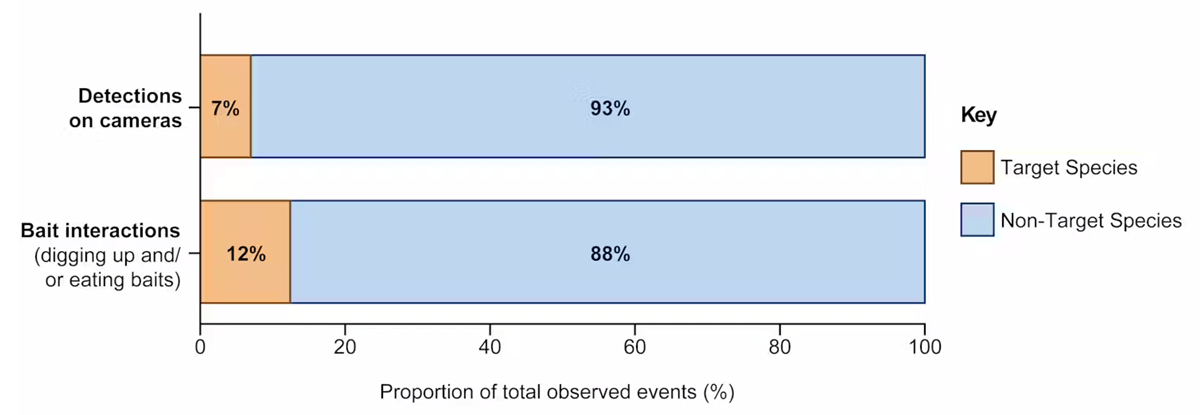
What did we find? Foxes and dingoes accounted for just 12% of the baits dug up or eaten. Of the 146 interactions with baits, 88% were non-target species – primarily, native mice species such as Mitchell’s hopping mouse (Notomys mitchellii) and silky mice (Pseudomys apodemoides).

The single dingo which took the bait dug it up only after 60 days. Foxes took the bait 17 times, but they were typically slow to do so too, averaging 41 days. By contrast, native mice dug up baits after an average of 13 days.

We also saw western grey kangaroos dig up and eat baits. Echidnas, rabbits and house mice often unearthed baits and left them uneaten on the surface, making them available to be found and consumed by other animals.

In sites with denser vegetation, we found native mice were more likely to dig up and eat the baits. But they were less likely to do so in open areas.

Dingoes and foxes (target species, in orange) did not dig up many baits relative to non-target species (in blue). Image credit: Rachel Mason/Deakin University

What about dingoes?

Baiting for dingoes and “wild dogs” is still done routinely, even though DNA testing shows the canids roaming Australia are mostly pure dingo. Recent research has shown that dingoes are largely avoiding breeding with domestic dogs. The “wild dogs” being poisoned to protect lambs and other livestock are almost all dingoes.

Shepherd dog breeds such as Maremma dogs have been bred to guard sheep from wild predators. Image credit: Marco Branchi/Shutterstock

This poses a major problem for baiting programs. While dingoes are susceptible to 1080 poison, they have lived in Australia for thousands of years. Aside from humans, dingoes are the top terrestrial predator everywhere outside Tasmania. To many First Nations people, these canids are culturally important and are often considered kin.

Graziers have long seen dingoes as a threat, given these predators can take sheep, goats, cattle and other livestock. But there are now non-lethal and highly effective predator-smart methods to safeguard livestock, such as predator-proof fencing and guardian animals such as Maremma dogs. These methods reduce livestock losses without the need to kill dingoes.

Keeping dingoes alive can often actually benefit graziers, as dingoes scare off or eat competing herbivores such as kangaroos and feral goats.

What does this mean for baiting?

Our research shows predator baiting has the potential to harm more native species than previously realised. That means baiting programs must be conducted carefully according to local conditions and the wildlife present.

More targeted methods for controlling predator species are being developed. Feral cats are now being targeted with machines which spray poisonous gel on their fur which cats will groom off, leaving other animals unharmed.

Using 1080 to control invasive predators has undoubtedly helped to save many native species. Even so, we must continue to evaluate the best approaches for predator control and wildlife conservation in Australia.

As the biodiversity crisis deepens and more species march towards extinction, we must find ways of better targeting our methods of control to protect livestock and safeguard native species – including the dingo.

The Conversation
Categories
Research

Assessing target and non-target species interactions with buried non-toxic meat baits across fire mosaics

Authors: Rachel T Mason, Anthony R Rendall, Robin D Sinclair, and Euan G Ritchie
Published in: Wildlife Research

Abstract

Context: Lethal 1080 baiting to control invasive predators, or to reduce livestock predation by canids, is a widespread management tool used throughout Australia and New Zealand. Techniques to reduce the impact of 1080 baiting on non-target species exist, but their efficacy, including effects of environmental variation and disturbance on baiting outcomes, remains poorly understood.
Aims: We aimed to experimentally quantify the extent to which target and non-target species dig up and consume buried baits, and to examine how habitat variation and fire affect such interactions.
Methods: Remote cameras were deployed for 70 days to monitor the fate of non-toxic baits in the semi-arid Big Desert-Wyperfeld region of southeastern Australia. Species digging up or eating baits (collectively ‘bait interactions’) were identified, and the effects of environmental factors on bait interaction rates were assessed.
Key results: Non-target species accounted for 128 (88%) of 146 total bait interactions, primarily native mice species. Target species interacted with fewer baits and took longer to record bait interactions, with foxes (Vulpes vulpes) averaging 41 days for 17 bait interactions and one dingo (Canis familiaris/Canis dingo) taking 60 days, whereas native mice interactions occurred after ~13 days. At sites where foxes and dingoes were detected, both target species almost always interacted with baits (83%), whereas non-target species interacted with baits at less than half of the sites they were detected (42%). Areas with greater variation in fire frequency (pyrodiversity) and mid-successional vegetation were associated with more native mice-bait interactions.
Conclusions: Non-target species interacted with baits more often and sooner than target species, suggesting efforts to reduce predator populations could have inadvertent effects on other species. The influence of fire and vegetation variables on bait interaction rates also highlights the importance of accounting for landscape features when designing lethal control programs.
Implications: Predator control can benefit native wildlife, and help to reduce livestock loss; however, managers must account for environmental factors that may influence which species are most likely to be affected by toxic baits, and by extension possible broader impacts on ecosystems. Monitoring to assess baiting outcomes and limit the negative consequences for non-target species constitutes best practice.
Mason RT, Rendall AR, Sinclair RD, Ritchie EG (2025) Assessing target and non-target species interactions with buried non-toxic meat baits across fire mosaics. Wildlife Research PDF DOI 
Categories
Publications Research

Biodiversity impacts of the 2019–2020 Australian megafires

Published in: Nature

Authors: Don A Driscoll, Kristina J Macdonald, Rebecca K Gibson, Tim S Doherty, Dale G Nimmo, Rachael H Nolan, Euan G Ritchie, Grant J Williamson, Geoffrey W Heard, Elizabeth M Tasker, Rohan Bilney, Nick Porch, Rachael A Collett, Ross A Crates, Alison C Hewitt, Elise Pendall, Matthias M Boer, Jody Gates, Rebecca L Boulton, Christopher M Mclean, Heidi Groffen, Alex C Maisey, Chad T Beranek, Shelby A Ryan, Alex Callen, Andrew J Hamer, Andrew Stauber, Garry J Daly, John Gould, Kaya L Klop-Toker, Michael J Mahony, Oliver W Kelly, Samantha L Wallace, Sarah E Stock, Christopher J Weston, Liubov Volkova, Dennis Black, Heloise Gibb, Joshua J Grubb, Melodie A McGeoch, Nick P Murphy, Joshua S Lee, Chris R Dickman, Victor J Neldner, Michael R Ngugi, Vivianna Miritis, Frank Köhler, Marc Perri, Andrew J Denham, Berin D E Mackenzie, Chris A M Reid, Julia T Rayment, Alfonsina Arriaga-Jiménez, Michael W Hewins, Andrew Hicks, Brett A Melbourne, Kendi F Davies, Matthew E Bitters, Grant D Linley, Aaron C Greenville, Jonathan K Webb, Bridget Roberts, Mike Letnic, Owen F Price, Zac C Walker, Brad R Murray, Elise M Verhoeven, Alexandria M Thomsen, David Keith, Jedda S Lemmon, Mark K J Ooi, Vanessa L Allen, Orsi T Decker, Peter T Green, Adnan Moussalli, Junn K Foon, David B Bryant, Ken L Walker, Matthew J Bruce, George Madani, Jeremy L Tscharke, Benjamin Wagner, Craig R Nitschke, Carl R Gosper, Colin J Yates, Rebecca Dillon, Sarah Barrett, Emma E Spencer, Glenda M Wardle, Thomas M Newsome, Stephanie A Pulsford, Anu Singh, Adam Roff, Karen J Marsh, Kye Mcdonald, Lachlan G Howell, Murraya R Lane, Romane H Cristescu, Ryan R Witt, Emma J Cook, Felicity Grant, Bradley S Law, Julian Seddon, Karleah K Berris, Ryan M Shofner, Mike Barth, Torran Welz, Alison Foster, David Hancock, Matthew Beitzel, Laura X L Tan, Nathan A Waddell, Pamela M Fallow, Laura Schweickle, Tom D Le Breton, Craig Dunne, Mikayla Green, Amy-Marie Gilpin, James M Cook, Sally A Power, Katja Hogendoorn, Renee Brawata, Chris J Jolly, Mark Tozer, Noushka Reiter, and Ryan D Phillips

Abstract

With large wildfires becoming more frequent, we must rapidly learn how megafires impact biodiversity to prioritize mitigation and improve policy. A key challenge is to discover how interactions among fire-regime components, drought and land tenure shape wildfire impacts.

The globally unprecedented 2019–2020 Australian megafires burnt more than 10 million hectares, prompting major investment in biodiversity monitoring. Collated data include responses of more than 2,000 taxa, providing an unparalleled opportunity to quantify how megafires affect biodiversity.

We reveal that the largest effects on plants and animals were in areas with frequent or recent past fires and within extensively burnt areas. Areas burnt at high severity, outside protected areas or under extreme drought also had larger effects. The effects included declines and increases after fire, with the largest responses in rainforests and by mammals.

Our results implicate species interactions, dispersal and extent of in situ survival as mechanisms underlying fire responses. Building wildfire resilience into these ecosystems depends on reducing fire recurrence, including with rapid wildfire suppression in areas frequently burnt. Defending wet ecosystems, expanding protected areas and considering localized drought could also contribute. While these countermeasures can help mitigate the impacts of more frequent megafires, reversing anthropogenic climate change remains the urgent broad-scale solution.

Driscoll DA, Macdonald KJ, Gibson RK, Doherty TS, Nimmo DG, Nolan RH, Ritchie EG, Williamson GJ, Heard GW, Tasker EM, Bilney R, Porch N, Collett RA, Crates RA, Hewitt AC, Pendall E, Boer MM, Gates J, Boulton RL, Mclean CM, Groffen H, Maisey AC, Beranek CT, Ryan SA, Callen A, Hamer AJ, Stauber A, Daly GJ, Gould J, Klop-Toker KL, Mahony MJ, Kelly OW, Wallace SL, Stock SE, Weston CJ, Volkova L, Black D, Gibb H, Grubb JJ, McGeoch MA, Murphy NP, Lee JS, Dickman CR, Neldner VJ, Ngugi MR, Miritis V, Köhler F, Perri M, Denham AJ, Mackenzie BDE, Reid CAM, Rayment JT, Arriaga-Jiménez A, Hewins MW, Hicks A, Melbourne BA, Davies KF, Bitters ME, Linley GD, Greenville AC, Webb JK, Roberts B, Letnic M, Price OF, Walker ZC, Murray BR, Verhoeven EM, Thomsen AM, Keith D, Lemmon JS, Ooi MKJ, Allen VL, Decker OT, Green PT, Moussalli A, Foon JK, Bryant DB, Walker KL, Bruce MJ, Madani G, Tscharke JL, Wagner B, Nitschke CR, Gosper CR, Yates CJ, Dillon R, Barrett S, Spencer EE, Wardle GM, Newsome TM, Pulsford SA, Singh A, Roff A, Marsh KJ, Mcdonald K, Howell LG, Lane MR, Cristescu RH, Witt RR, Cook EJ, Grant F, Law BS, Seddon J, Berris KK, Shofner RM, Barth M, Welz T, Foster A, Hancock D, Beitzel M, Tan LXL, Waddell NA, Fallow PM, Schweickle L, Le Breton TD, Dunne C, Green M, Gilpin A-M, Cook JM, Power SA, Hogendoorn K, Brawata R, Jolly CJ, Tozer M, Reiter N, Phillips RD (2024) Biodiversity impacts of the 2019–2020 Australian megafires. Nature PDF DOI

Categories
Publications Research

Widespread resilience of animal species, functional diversity, and predator–prey networks to an unprecedented gigafire

Published in: Journal of Applied Ecology

Authors: Grant D Linley, Chris J Jolly, Eamonn I F Wooster, Emma E Spencer, Mitchell A Cowan, William L Geary, Alana de Laive, Damian R Michael, Euan G Ritchie, and Dale G Nimmo

Abstract

Climate change is altering fire regimes globally, leading to an increased incidence of large and severe wildfires, including gigafires (>100,000 ha), that homogenise landscapes. Despite this, our understanding of how large, severe wildfires affect biodiversity at the landscape scale remains limited.

We investigated the impact of a gigafire that occurred during the unprecedented 2019–20 Australian ‘Black Summer’ on terrestrial fauna. We selected 24 study landscapes, each 0.785 km² in size, that represented a gradient in the extent of high severity fire, unburnt vegetation, and the diversity of fire severity classes (‘pyrodiversity’). We used wildlife cameras to survey biodiversity across each landscape and quantified species activity, community and functional diversity, and predator–prey network metrics. We used Bayesian mixed-effects models to assess the influence of fire-induced landscape properties on these measures.

Most native species showed resilience to the 2019–20 wildfires, displaying few relationships with fire-induced properties of landscapes, including the extent of high severity fire, unburnt vegetation, or pyrodiversity.

Community and functional diversity and measures of predator–prey networks were also largely unaffected by fire-induced landscape properties, although landscapes with a greater proportion of high severity fire had higher abundance and richness of introduced animal species.

Despite prevailing narratives of widespread ecological destruction following the 2019–20 wildfires, our findings suggest widespread resilience, potentially facilitated by evolutionary adaptations of animals to fire. Interventions aimed at helping such species recover may not be necessary and could instead focus on the subset of species that are vulnerable to severe fire. While mixed-severity fires are often advocated to promote biodiversity through pyrodiversity, our results suggest that such management efforts might not be necessary in our study region. Given that severe fire favours introduced animal species, invasive species management could focus on large, severely burnt areas.

Linley GD, Jolly CJ, Wooster EIF, Spencer EE, Cowan MA, Geary WL, De Laive A, Michael DR, Ritchie EG, Nimmo DG (2024) Widespread resilience of animal species, functional diversity, and predator–prey networks to an unprecedented gigafire. Journal of Applied Ecology PDF DOI

Categories
Research Science communication The Conversation

The Conversation: The power of one: solitary carnivores outkill group hunters

Mark Elbroch, Panthera

By Luke Emerson and Euan Ritchie, Deakin University.

This article is republished from The Conversation under a Creative Commons license. Read the original article.

Earth’s majestic “apex predators” are some of the most prolific hunters in the world. But which ones kill the most?

Such information allows us to better understand how different predators affect their environment. It can also guide hunting quotas and help evaluate how humans affect carnivores.

These apex predators perform vital roles in ecosystems. Yet tragically they are among the world’s most threatened animals. Carnivores frequently come into conflict with humans, particularly over livestock and public safety.

Our approach

We examined 196 papers that either quantified large mammal carnivore kill rates, or reported data we could use to calculate the rates ourselves.

We focused on the large land-based carnivores weighing 15 kilograms or more. We also searched for kill rate studies on four smaller species — coyote, wolverine, fossa (a cat-like predator found in Madagascar) and the Tasmanian Devil — as they’re all considered apex predators in certain regions and ecosystems.

We only found kill rate estimates for 17 (55%) of the 31 carnivore species included in our review. Studies came from 27 countries across five continents.

The research focused on mammals weighing 15 kg or more. Jurgens Potgieter, Shutterstock

Carnivores hunt in different ways

We found kill rates differ between carnivores with different social structures and hunting strategies.

Social predators, such as wolves and lions, tend to kill fewer animals per carnivore than solitary hunters such as bears, tigers and Eurasian lynx. For example, on average grey wolves made a kill every 27 days per wolf, compared with every four days per Eurasian lynx.

Larger wolf packs can bring down large animals such as bison more easily. Similarly, groups of cheetahs can tackle larger prey than solitary cheetahs. This could mean they don’t need to hunt as often.

Working as a team may also reduce losses to scavengers, as groups can better defend their kills through sheer numbers. Or they might be better at scavenging and stealing (“kleptoparasitism”) from others.

Canine predators such as wolves and African wild dogs often rely on high-energy pursuits over long distances. For example, grey wolves can pursue prey for more than 20 kilometres. In contrast, cats rely on stealth, using an ambush hunting strategy. This saves energy.

Solitary large carnivores such as tigers, leopards and Eurasian lynx, which mainly hunt hooved mammals, have similar kill rates regardless of body mass. This suggests large land-based carnivores are compelled to hunt prey closer to their own size or larger, to compensate for the energy used in the hunt.

Smaller carnivores such as cheetahs, pumas and African wild dogs often kill more prey than their larger counterparts, but only consume about half of what they kill.

This behaviour benefits other species such as lions, bears and wolves and is likely a consequence of having to compensate for the theft and loss of food. Pumas are thought to provide more than 1.5 million kilograms of carrion a day across North and South America.

If you’ve seen The Lion King movie, you’d be forgiven for thinking hyenas largely steal and scavenge their food. But that’s not the case. Lions often steal from hyenas, as well as from other carnivores such as cheetahs and African wild dogs.

Bias in kill rate research

More than half (55%) of all kill rate studies have been conducted in North America. Africa follows with almost a quarter (24%), then Europe (12.5%).

Asia was a long way behind with 7% of all kill rate studies. That’s just 13 studies covering six species. This is despite being the largest continent, home to 17 (55%) of the 31 large carnivore species included in our review.

No reliable kill rate studies have been published from Australia.

A third (33%) of all kill rate studies focused on grey wolves, followed by pumas (20%), lions (12%) and Eurasian lynx (8%). This means we know little about the predatory behaviour and roles of other large carnivores.

Grey wolves are considered a threat to livestock and wildlife that humans value. This has prompted significant investment in research to understand their predatory behaviour and that of other large North American carnivores.

Such work has subsequently been used to inform appropriate management and conservation of these predators and their prey.

A third of all studies focused on grey wolves. Evelyn D. Harrison, Shutterstock

Carnivores bring benefits

Kill rate studies provide more than just a tally of carnivore behaviour. They offer deeper insights into the relationships between predators and prey, and their effects on ecosystems.

Large carnivores shape ecosystems by scaring and killing prey, which can change their behaviour, distribution and abundance. They also supply food to other species, affecting the flow of nutrients and energy.

In many ways, large carnivores also help people. They can reduce the risk of vehicle collisions, by killing deer that might otherwise wander onto roads. They may limit the spread of disease by preying on sick animals, and control herbivores, aiding livestock producers.

Yet carnivores, including Australia’s dingo, are still widely persecuted. We need to do all we can to maintain their pride of place at the pinnacle of Earth’s ecosystems.

Of course, if you really want to know which species is the biggest killer, it’s humans. We are the dominant predator across Earth.The Conversation

The Conversation

Categories
Publications Research

Wildlife restoration in fragmented landscapes: Trialling wild-to-wild translocation with two common reptiles

Authors: Dylan M Westaway, Chris J Jolly, David M Watson, Maggie J Watson, Damian R Michael, Grant D Linley, Ben Holmes, Euan G Ritchie, Anne Buchan, Ella Loeffler, and Dale G Nimmo

Published in: Biological Conservation

Abstract

Translocations are an increasingly popular conservation tool, although their use to date has been largely reactive, often attempting to stave off the extinction of threatened species. Recently, a more proactive concept of ‘wildlife restoration’ has been proposed, involving regular, short-distance, community-driven translocations of common but patchily distributed species within agricultural and urban landscapes.

We trialled this concept by carrying out experimental translocations of two agamid lizard species from the Little Desert National Park in south-eastern Australia, where they are abundant, to fragments of similar habitat in the adjacent agricultural landscape, where they were absent, or occurring in low numbers. Study animals were monitored via radio-telemetry to assess survival, body condition, site fidelity, activity area, movement and microhabitat use of hard-release and soft-release animals compared to control animals.

Survival was generally high over the monitoring period (up to 64 days) with only six (16 %) confirmed deaths and was similar between translocation treatments. Body condition, site fidelity, activity area, movement rate, and microhabitat use were similar between translocated and control animals. Lizards subjected to temporary pens (soft-release) exhibited similar outcomes to those released immediately (hard-release).

While the assessment of breeding and population establishment necessitates long-term monitoring, our short-term findings highlight the resilience of translocated reptiles, supporting the notion that ‘mainstreaming’ fauna translocations could be a viable and effective conservation intervention.

Westaway DM, Jolly CJ, Watson DM, Watson MJ, Michael DR, Linley GD, Holmes B, Ritchie EG, Buchan A, Loeffler E, Nimmo DG (2024) Wildlife restoration in fragmented landscapes: Trialling wild-to-wild translocation with two common reptiles. Biological Conservation PDF DOI

Categories
Publications Research

A global assessment of large terrestrial carnivore kill rates

Authors: Luke D Emerson, Heiko U Wittmer, L Mark Elbroch, Kristal Kostoglou, Kimberley J Bannister, Jared J Psaila, Desley Whisson, and Euan G Ritchie

Published in: Biological Reviews

Abstract

Through killing and instilling fear in their prey, large terrestrial carnivores shape the structure and function of ecosystems globally. Most large carnivore species have experienced severe range and population declines due to human activities, and many are now threatened with extinction. Consequently, the impacts of these predators on food webs have been diminished or lost completely from many ecosystems.

Kill rates provide a fundamental metric for understanding large carnivore ecology and assessing and comparing predation within and across ecological communities.

Our systematic review of large terrestrial mammalian carnivore kill rates reveals significant positive geographic (North America, Europe, and Africa) and taxonomic (grey wolf Canis lupus, puma Puma concolor, lion Panthera leo, and Eurasian lynx Lynx lynx) bias, with most studies apparently motivated by human-carnivore conflict over access to ungulate prey and wildlife management objectives.

Our current understanding of the behaviour and functional roles of many large carnivore species and populations thus remains limited. By synthesising and comparing kill rates, we show that solitary carnivores (e.g. brown bears Ursus arctos and most felids) exhibit higher per capita kill rates than social carnivores. However, ungulate predation by bears is typically limited to predation of neonates during a short period. Lower per capita kill rates by social carnivores suggests group living significantly reduces energetic demands, or, alternatively, that group-living carnivores defend and consume a greater proportion of large prey carcasses, or may acquire more food through other means (e.g. scavenging, kleptoparasitism) than solitary hunters.

Kill and consumption rates for Canidae — measured as kilograms of prey per kilogram of carnivore per day — are positively correlated with body mass, consistent with increasing energy costs associated with a cursorial hunting strategy. By contrast, ambush predators such as felids show an opposite trend, and thus the potential energetic advantage of an ambush hunting strategy for carnivores as body mass increases. Additionally, ungulate kill rates remain relatively constant across solitary felid body sizes, indicative of energetic constraints and optimal foraging.

Kill rate estimates also reveal potential insights into trophic structuring within carnivore guilds, with subordinate carnivores often killing more than their larger counterparts, which may be indicative of having to cope with food losses to scavengers and dominant competitors. Subordinate carnivores may thus serve an important role in provisioning food to other trophic levels within their respective ecosystems.

Importantly, kill rates also clarify misconceptions around the predatory behaviour of carnivores (e.g. spotted hyaenas Crocuta crocuta and wolverines Gulo gulo are often considered scavengers rather than the capable hunters that they are) and thus the potential impacts of various carnivore species on their ecological communities.

Despite the importance of kill rates in understanding predator-prey interactions, their utility is not widely recognised, and insufficient research limits our ability to fully appreciate and predict the consequences of modified predation regimes, justify current management actions affecting carnivores, or inform effective conservation measures.

Together with other important research on predator-prey interactions, robust kill rate studies that address the research deficiencies we highlight will provide a deeper understanding of the foraging behaviours and potential ecosystem impacts of many of the world’s carnivores, thus aiding effective conservation and management actions.

Emerson LD, Wittmer HU, Elbroch LM, Kostoglou K, Bannister KJ, Psaila JJ, Whisson D, Ritchie EG (2024) A global assessment of large terrestrial carnivore kill rates. Biological Reviews PDF DOI

Categories
Publications Research

Balancing livestock production and environmental outcomes in northern Australia’s tropical savanna under global change

Authors: Rebecca K Runting, Darran King, Martin Nolan, Javier Navarro, Raymundo Marcos-Martinez, Jonathan R Rhodes, Lei Gao, Ian Watson, Andrew Ash, April E Reside, Jorge G Álvarez-Romero, Jessie A Wells, Euan G Ritchie, Michalis Hadjikakou, Don A Driscoll, Jeffery D Connor, Jonathan Garber, and Brett A Bryan

Published in: Environmental Research Letters

Abstract

Livestock production is an integral part of the global food system and the livelihoods of local people, but it also raises questions of environmental sustainability due to issues such as greenhouse gas (GHG) emissions, biodiversity decline, land degradation, and water use. Further challenges to extensive livestock systems may arise from changes in climate and the global economy (particularly variation in prices for livestock and carbon). However, significant potential exists for both mitigating these impacts and adapting to change via altering stocking rates, managing fire, and supplementing cattle diets to reduce methane emissions.

We developed an integrated, spatio-temporal modelling approach to assess the effectiveness of these options for land management in northern Australia’s tropical savanna under different global change scenarios. Performance was measured against a range of sustainability indicators, including environmental (GHG emissions, biodiversity, water intake, and land condition) and agricultural (profit, beef production) outcomes.

Our model shows that maintaining historical stocking rates is not environmentally sustainable due to the accelerated land degradation exacerbated by a changing climate. However, planned early dry season burning substantially reduced emissions, and in our simulations was profitable under all global change scenarios that included a carbon price. Overall, the balance between production and environmental outcomes could be improved by stocking below modelled carrying capacity and implementing fire management. This management scenario was the most profitable (more than double the profit from maintaining historical stocking rates), prevented land degradation, and reduced GHG emissions by 23%.

By integrating the cumulative impacts of climate change, external economic drivers, and management actions across a range of sustainability indicators, we show that the future of rangelands in Australia’s savannas has the potential to balance livestock production and environmental outcomes.

Runting RK, King D, Nolan M, Navarro J, Marcos-Martinez R, Rhodes JR, Gao L, Watson I, Ash A, Reside AE, Álvarez-Romero JG, Wells JA, Ritchie EG, Hadjikakou M, Driscoll DA, Connor JD, Garber J, Bryan BA (2024) Balancing livestock production and environmental outcomes in northern Australia’s tropical savanna under global change. Environmental Research Letters PDF DOI 

Categories
Publications Research

Vertebrate scavenging in Australia is shaped by a complex interplay of bioregional, seasonal and habitat factors

Authors: Emma E Spencer, Christopher R Dickman, Aaron Greenville, Phillip Barton, Euan G Ritchie, and Thomas M Newsome

Published in: Journal of Zoology

Abstract

Carcass scavenging by vertebrates is a critical ecosystem service that is influenced by environmental factors such as season and habitat. However, there is limited understanding of the role that these factors play in shaping scavenging patterns across different bioregions.

We used camera traps to monitor vertebrate scavengers at 120 kangaroo (Family: Macropodidae) carcasses that were positioned across different seasons (warm/cool) and habitats (open/closed canopy) in three disparate desert, subalpine and temperate bioregions in Australia.

Our survey identified 27 species that scavenged carcasses and revealed clear differences in scavenging patterns across the three bioregions. Carcass use was highest for feral cats, birds of prey, corvids and red foxes in the desert bioregion; for reptiles and dingoes in the temperate bioregion and for feral pigs, possums and dingoes in the subalpine bioregion. Bioregional differences in scavenger guild composition explained >4.6 times more variation in scavenger guild dissimilarity than season and >9.8 times more variation than habitat. Further, habitat had few effects on scavenger communities or carcass detection and use, whereas season was a strong predictor of these responses. Across bioregions, there were some general seasonal and habitat scavenging trends, with mammals and birds often using carcasses more frequently in cooler seasons and birds detecting carcasses faster in open habitat. However, there was also extensive within-bioregion seasonal variation. For example, depending on bioregion, some animals scavenged more frequently or detected carcasses faster in warmer seasons (i.e. birds and reptiles).

Our results show that vertebrate scavenging is mediated by a complex interplay of environmental variables, especially seasonality, which may operate differently across bioregions. These findings have implications for understanding variability in vertebrate scavenging patterns and, in turn, functionally redundant or complementary scavenging processes.

Spencer EE, Dickman CR, Greenville A, Barton P, Ritchie EG, Newsome TM (2024) Vertebrate scavenging in Australia is shaped by a complex interplay of bioregional, seasonal and habitat factors. Journal of Zoology PDF DOI

Categories
Research

7.30: saving Lee Point

Lee Point (Binybara, in local Larrakia language) is part of a woodland biodiversity corridor, 20 kilometres from Darwin’s CBD. Globally significant thanks to it abundance of wildlife, it’s under threat from a Defence Housing Australia development backed by the state and federal governments.

Lee Point’s coastline and old-growth forrest are home to more than a quarter of the bird species in Australia, including the emblematic Gouldian finch, as well as threatened mammals like the northern brush-tailed possum.

How can we save a place of such significant ecological and cultural value? I spoke to the ABC’s Roxanne Fitzgerald for 7.30.