
Postdoctoral research fellows ● PhD candidates ● Honours students ● Past lab members and projects ● Prospective students ● Volunteer opportunities

Interested in joining our group?
Maybe this could be your next field site!
I am always interested in speaking to high-achieving, energetic and self-motivated students about potential honours and PhD projects.
And we are always looking for volunteers to lend a hand out in the field too.
Postdoctoral research fellows

Amanda Lo Cascio
I have an interest in applied ecological problems with direct consequences for conservation management.
My research is focused on better understanding how animals utilise and move through landscapes, and how this is influenced by landscape configuration, species communities and disturbance.
Currently, my work utilises spatially explicit models to estimate population size, density, and individual movement of a vulnerable population of dingoes in semi-arid Victoria.
Incorporating supervised learning of high resolution remotely sensed spatial data will assist in determining fine scale population dynamics to inform appropriate conservation actions.
PhD candidates
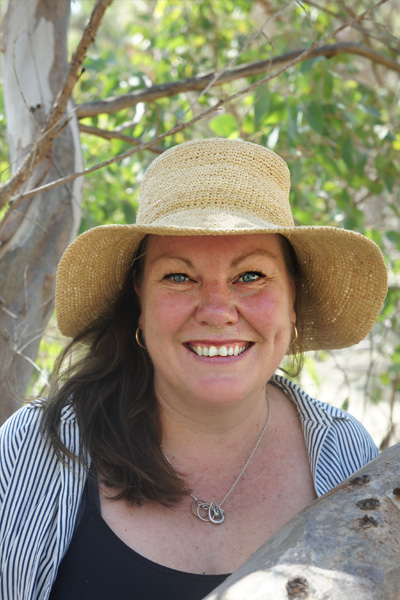
Louise Buckley
I am based in regional Victoria on Wadawurrung Country. I would like to acknowledge the Traditional Owners of this land, the elder’s past, present and emerging.
I am a natural resource planning and conservation specialist. I work with the private and public sector developing management tools for the conservation of species and habitat. My PhD is a social science, applied ecology project. It will be centered on planning for the strategic management of culturally significant values in a changing climate. Using place-based community-centered case studies, the work will focus on caring for Country, land management and biodiversity conservation programs and projects in Victoria.
My supervisory team consists of Tim Neale (Alfred Deakin Institute), Euan Ritchie (Centre for Integrated Ecology) and Will Smith (Alfred Deakin Institute).

Luke Emerson
My PhD research examines the foraging ecology of pumas across their geographic range. Using GPS collar data, kill site images and genetic information, from multiple study sites across North and South America, we will advance understanding of the factors that influence puma prey selection, kill rates and habitat use. We will also shed light on sociality and resource sharing among pumas relative to their spatial ecology, and the importance of non-native prey species. This research will provide insight into the ecology and impact of an apex predator, and will have implications for conservation and management initiatives in other systems where large carnivores occur.
My supervisory dream team consists of Prof. Euan Ritchie and Dr Desley Whisson (Deakin University), A/Prof Heiko Wittmer (Victoria University of Wellington) and Dr Mark Elbroch (Panthera).
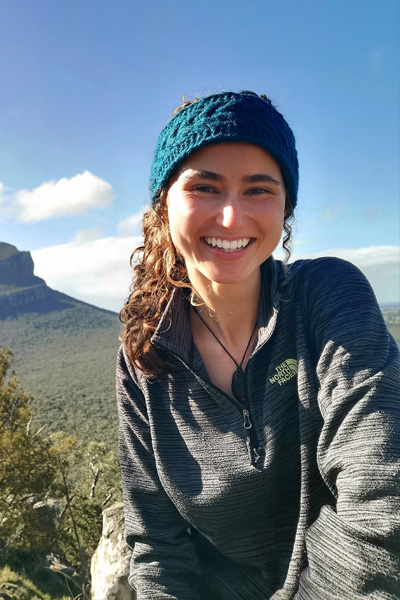
Meg Farmer
My PhD research examines changes in long-nosed potoroo ecology as predation pressure by feral cats is reduced on French Island. Through extensive trapping surveys, GPS tracking and habitat analysis, my research aims to quantify potoroo habitat use and understand how cats affect potoroo populations and behaviours (spatially and temporally).
Investigating the persistence of a threatened mammal species alongside of one of the world’s most ubiquitous invasive predators has broad applicability across threatened species (prey) conservation. My research can be applied in habitat management contexts, exploring novel methods that may have high conservation return for critical weight range mammals, particularly in situations where feral predator eradication is infeasible.
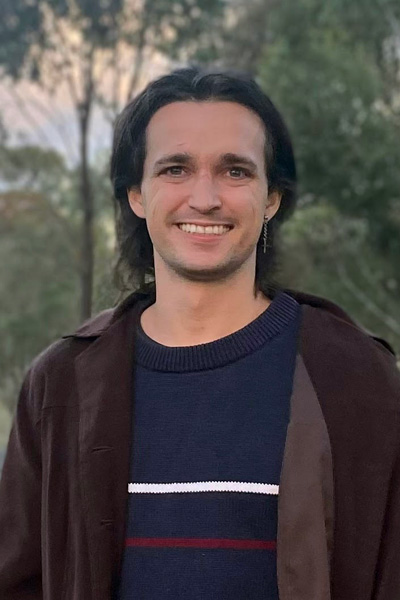
Emmet Mulcahy
My PhD combines invasive species ecology with social science to investigate public perceptions of invasive species and their management.
I’ll be examining different values, opinions, and beliefs through interviews with practitioners, special interest groups, and First Nations land managers. I’ll also conduct a wide-ranging survey of the Australian public to better understand how perceptions vary depending on the target species and control method used.
My findings could help decision-makers in government and conservation develop management plans with greater social license to improve outcomes for biodiversity.
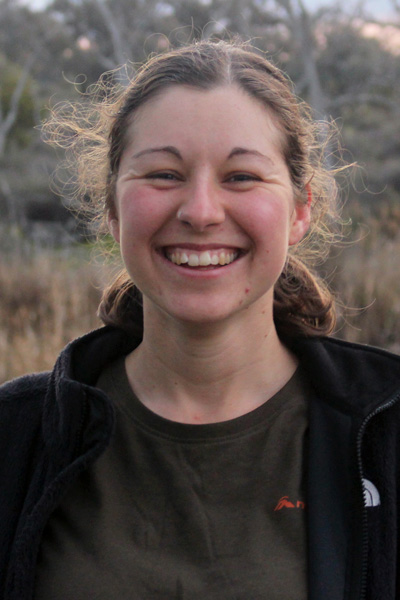
Aviya Naccarella
My PhD focuses on understanding the ecological interaction between mammals, plants, and fungi.
Using a combination of scat and soil analysis, vegetation surveys and glasshouse experiments my research aims to understand what role digging, fungus-feeding mammals can play in restoration through their contribution to ecosystem function.
The findings of my research will contribute to our understanding of mammal-fungi-plant interactions and provide valuable information for researchers and practitioners to inform restoration projects aimed at reinstating ecosystem function.
Honours students
Kat Hunter
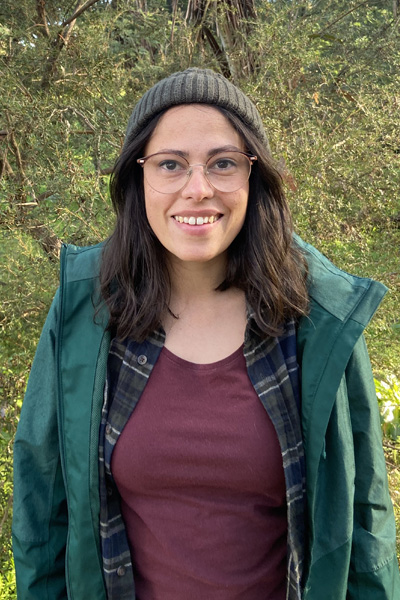
My honours research investigates the movement ecology of platypuses with a focus on their home range size and habitat preferences.
By using radio tracking alongside habitat surveys and water nutrient analysis, I examine patterns of movement and resource selection.
These insights aim to inform freshwater habitat management strategies to support declining platypus populations in the face of environmental change.
Past lab members and projects
Rachel Mason (PhD 2025)
Dingo ecology in semi-arid mallee environments. 𝕏 racheltmason
Ange Pestell (PhD 2024)
Faunal assemblages across a range of fire age classes the Victorian Mallee and Wimmera. 𝕏 pestell37
Georgina de Beaujeu (PhD 2024)
Co-benefits for urban nature and people.
Dylan Westaway (PhD 2024)
Reptile conservation in the fire-prone Victorian mallee.
Eilysh Thompson (PhD 2024)
The role of dingoes as a trophic regulator within alpine and sub-alpine ecosystems.
Grant Linley (PhD 2024)
The impact of the 2019–2020 wildfires on terrestrial species in forests of south-eastern Australia.
Anne Eichholtzer (PhD 2024)
Monitor reptiles and amphibians with novel camera technology, machine learning, and citizen scientists.
Billy Geary (PhD 2023)
Managing ecosystems and conserving biodiversity by understanding the interactions between threats and ecological processes. Twitter
Jade Bell (honours 2023)
Predator–prey interactions and using using lace monitor (Varanus varius) scent to address overbrowsing of eucalypts.
Harry Moore (PhD 2022)
Ecology of northern quolls (Dasyurus hallucatus) in the Pilbara, Western Australia. Twitter
Shannon Braun (masters 2022)
Fox and goanna interactions. Twitter
Te Ao Marama Eketone (honours 2022)
Population ecology and behaviour of eastern barred bandicoots and long-nosed potoroos on French Island after a feral cat eradication program. Twitter
Georgia Kielbaska (honours 2022)
Factors affecting the potential translocation of Mitchell’s hopping mouse (Notomys mitchellii) in the Wimmera-Mallee region.
Kristy Williams (honours 2022)
Habitat preferences of the long-nosed potoroo (Potorous tridactylus) on French Island.
Claire Tingate (honours 2022)
Assessing the value of linear roadside vegetation for the threatened greater glider (Petauroides volans) and other arboreal mammals in the Strathbogie Ranges.
Nathan Waddell (honours 2022)
Occupancy rates of arboreal species in chainsaw hollows in Gippsland.
Robin Sinclair (honours 2020)
Red fox diet in Gariwerd (Grampians) National Park. Twitter
Emily Reynolds (honours 2020)
Backyard bandicoots: What factors determine habitat suitability?
Tahlia Townsend (honours 2020)
Population ecology of the eastern barred bandicoot.
Sarah Maclagan (PhD 2020)
Ecology of the endangered Southern Brown Bandicoot in peri-urban Melbourne. Twitter
Lily Van Eeden (PhD 2020)
Wildlife management of dingoes, Canis dingo. Twitter
Rachel Lee (honours 2020)
Invertebrate translocations globally. Twitter
Mary Thorpe (honours 2020)
Predator and herbivore occupancy and habitat use in response to fox baiting in the Little Desert, Victoria.
Meg Farmer (honours 2019)
Distribution, abundance and behaviour of long-nosed potoroos (Potorous tridactylus) on French Island.
Ella Loeffler (honours 2019)
The foraging ecology of eastern barred bandicoots in newly established island populations. Twitter
Vivianna Miritis (honours 2019)
Understanding island cat ecology for pest management and threatened species recovery. Twitter
Tom Newsome (postdoc 2017)
Predator management in Australia: Lessons from interactions between wolves and cougars in north-east Washington USA. Twitter Website
Rebecca Cherubin (honours 2018)
Evaluating the ecological impacts of feral horses in the Alps.
Matt Sleeth (honours 2017)
Home range ecology and microhabitat use of the invasive wolf snake (Lycodon capucinus) of Christmas Island.
Lauren Halstead (honours 2017)
The ecological role of eastern barred bandicoots in a newly established island population.
Bronwyn Hradsky (PhD 2016)
Interactions between invasive predators, native mammals and fire in a forest ecosystem. Twitter Website
Blake Allan (PhD 2016)
Specialist versus generalist species: a comparative ecological study of common and mountain brushtail possums. Twitter
Michael Wysong (PhD 2016)
Predator ecology in the arid rangelands of Western Australia: spatial interactions and resource competition etween an apex predator, the dingo Canis dingo, and an introduced mesopredator, the feral cat Felis catus. Twitter
Leanne Greenwood (honours 2016)
Monitoring effort to effectively assess occupancy changes in terrestrial mammal species in Wilsons Promontory National Park.
Evie Jones (honours 2016)
Factors influencing feral cat density and distribution in a mallee ecosystem.
Gavin Trewella (honours 2016)
Do dingoes (Canis dingo) facilitate behaviourally-mediated trophic cascades in mallee ecosystems?
Tim Doherty (postdoc 2016)
Fire, predator and prey relationships in semi-arid Victoria. Twitter
Evelyn Chia (PhD 2016)
Wildfire, landscape heterogeneity and fauna in fire-prone forests.
Michelle Bassett (PhD 2016)
Wildfire, mammals and their habitats in a fire-prone forest ecosystem. Twitter
Hayley Geyle (honours 2015)
Survey design for detecting declines in the threatened brush-tailed rabbit-rat Conilurus penicillatus on the Tiwi Islands of the Northern Territory. Twitter
Harry Moore (honours 2015)
Spatial and temporal interactions between predators and small mammals in semi-arid Australia. Twitter
Leila Brook (PhD 2015)
Predator guild interactions in northern Australia: behaviour and ecology of an apex predator, the dingo Canis lupus dingo, and an introduced mesopredator, the feral cat Felis catus.
Cassandra Holt (honours 2015)
The distribution of mammals in relation to habitat at Wilsons Promontory. Twitter
Thomas Healey (honours 2014)
Fire and the distribution of a herbivore in semi-arid Australia. Twitter
Jess Lawton (honours 2014)
What drives the distribution of a small mammal (Notomys mitchellii) in a fire prone landscape? Twitter
Ray Alexander (honours 2014)
Habitat selection of the red fox (Vulpes vulpes) in the Otway Ranges. Twitter
Billy Geary (honours 2014)
Predators and prey in flames: Mammalian trophic relationships in fire-prone, semi-arid Victoria. Twitter
Hayley Davis (honours 2014)
Does fire influence termites? Examining the pyrodiversity begets biodiversity hypothesis. Twitter
Amber Fordyce (honours 2013)
The impact of planned fire on microhabitat use in the bush rat.
Rebecca Nightingale (honours 2013)
Understanding social behaviour of Tasmanian devils (Sarcophilus harrisii) in captivity: implications for conservation and management.
Shannon Braun (honours 2013)
The influence of fire and microhabitat on predation pressure in semi-arid Australia: an experimental case-study using lizards.
Catherine Payne (honours 2012)
Understanding the drivers of red fox (Vulpes vulpes) distribution and activity in semi-arid Australia. Twitter
Lucy Gow (honours 2012)
Habitat associations and daily activity patterns of Wilsons Promontory’s mammals.
Kathlean Kean (honours 2011)
Human dimensions of dingo and wild dog management in Victoria.
Tanya Rosewarne (honours 2011)
Understating animal behaviours in captive insurance populations: the Tasmanian devil as a case study.
Prospective students
I am always interested in speaking to high-achieving, energetic and self-motivated students about potential honours or PhD projects.
Our group’s work is always focused on applied ecology that seeks solutions to issues of genuine conservation concern. Our work tends to occur at the landscape-scale and be focused largely on mammals, but we are always open to developing projects that address a broad range of topics.
Students who have extensive field experience surveying wildlife, and have strong communication and quantitative skills will be particularly favoured. I also place a strong emphasis on students feeling well-supported by our group and therefore expect regular interaction and attendance at lab meetings and social events.
If you are interested in joining our group, please email me specifically addressing the following:
- Why do you want to undertake further study?
- What are your short- and long-term goals?
- What expertise and experience will you bring to our group?
- What area of research interests you most and why?
- What are your relevant qualifications (undergraduate units taken and marks, field- and lab-based experience, other relevant qualifications, skills and experience)?
Please also include details of three referees.
For more information and submission deadlines for applications, refer to the following:
Volunteer opportunities
From time-to-time we need help out in the field. Volunteer field work is valuable, rewarding, and can be great fun.
Opportunities will be posted on the Deakin University Ecology Volunteer Register on Facebook.
 Applied ecology and conservation research group